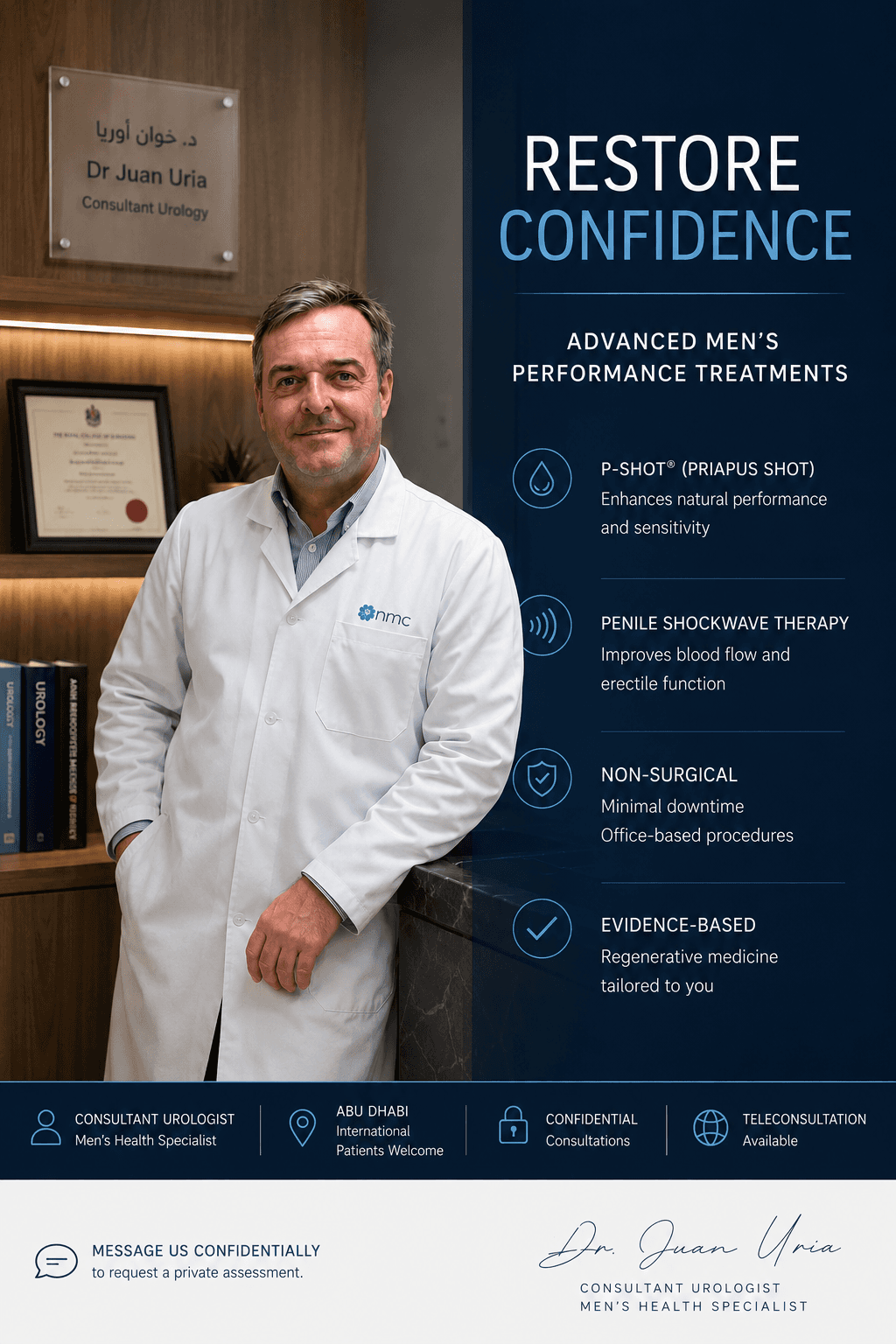
Dr. Juan Uría
Consultant Urologist & Andrologist
Over 30 years of clinical experience in urology, oncology, and men's health. DOH Abu Dhabi licensed.
Andrology
Andrology · Men's Health · Abu Dhabi
Conditions & diagnostic assessments
Erectile dysfunction
Erectile dysfunction is the persistent difficulty in achieving or maintaining an erection sufficient for satisfactory sexual activity. It is common, it is treatable, and it is frequently the first visible sign of a cardiovascular or metabolic problem that has not yet been diagnosed — which is why it warrants a proper medical assessment rather than self-medication.
02Testosterone deficiency & TRT
Testosterone deficiency, or male hypogonadism, is diagnosed when consistently low morning testosterone levels occur together with compatible symptoms — not on a single blood test and not on symptoms alone. Testosterone replacement therapy is effective when that diagnosis is correct, and inappropriate when it is not, which makes accurate diagnosis the whole of the problem.
03Peyronie's disease
Peyronie's disease is the formation of fibrous scar tissue in the penis, producing curvature, deformity, shortening and often pain. It is a recognised medical condition, not a cosmetic complaint, and the timing of assessment matters: the treatment options available differ substantially between the active early phase and the stable later phase.
04Male infertility
A male factor contributes in roughly half of couples who have difficulty conceiving, either alone or alongside a female factor. This means the man should be assessed from the start rather than after the female investigation has concluded — and that assessment begins with a semen analysis, which is simple, quick and frequently skipped.
05Premature ejaculation
Premature ejaculation is ejaculation that consistently occurs sooner than the man wishes, causing distress. It is one of the most common male sexual complaints and one of the most treatable, yet it is among the least often brought to a doctor — and it responds better when the cause is identified rather than assumed to be psychological.
06Penile Doppler ultrasound
Penile Doppler uses ultrasound to assess blood flow during an erection. It can help investigate suspected vascular erectile dysfunction or selected cases of Peyronie's disease. Dr. Juan Uría can assess whether this test would change your treatment plan at NMC Royal Hospital Khalifa City, Abu Dhabi.
07Sperm DNA fragmentation & failed IVF
An elevated sperm DNA fragmentation result needs interpretation alongside the semen analysis and both partners' fertility history. After unsuccessful IVF or ICSI, Dr. Juan Uría can review the male contribution in Abu Dhabi and coordinate next steps with your fertility team. A raised result alone does not explain every failed cycle.
08TRT & fertility planning
Testosterone treatment can suppress sperm production, sometimes to zero. If you want children now or in the future, discuss this before starting TRT. Dr. Juan Uría offers assessment of low testosterone and male fertility in Abu Dhabi, including a review when sperm counts fall during treatment.
Treatments
Penile implant surgery
A penile implant is a surgically placed device that provides rigidity for sexual intercourse when other erectile dysfunction treatments have failed or are unsuitable. Cylinders sit within the erectile chambers of the penis. The procedure changes the natural erectile mechanism permanently: removing the device does not restore the erections a man had before surgery.
10Shockwave therapy (LI-ESWT)
Low-intensity extracorporeal shockwave therapy applies acoustic pulses to the erectile tissue with the aim of improving penile blood flow. Of the regenerative options offered for erectile dysfunction it is the one with the most clinical evidence behind it, and European guidance recognises it as an option in mild vasculogenic erectile dysfunction — but the effect is moderate, it is not permanent, and it does not replace finding out why the erectile dysfunction is there.
11PRP therapy (P-Shot)
Platelet-rich plasma therapy, offered under names such as the P-Shot, injects a concentrate prepared from the patient's own blood into the erectile tissue. It is established practice in regenerative andrology in the UAE, it is consistently well tolerated across the randomised trials, and in mild to moderate erectile dysfunction several of those trials and their meta-analyses report improvement in erectile function scores. It is used as part of a treatment plan built on a diagnosis, not as a substitute for making one.
12Penile girth filler
Hyaluronic acid filler for penile girth is a cosmetic, non-surgical procedure that adds volume beneath the skin of the shaft. It changes appearance, not function: it does not treat erectile dysfunction, it does not add length, and the effect is temporary. Most men who ask about it have anatomy within the normal range, so the first and most useful part of the consultation is establishing what is actually being asked for.
13Peptide therapy
"Peptide therapy" covers two things that have almost nothing in common. A small number of peptide medicines are licensed, well understood and genuinely indicated in andrology — hCG and FSH for men whose testicles are not being signalled properly, and for protecting fertility. A much larger group sold as peptide therapy — BPC-157, TB-500, ipamorelin, CJC-1295 and their relatives — is not approved for human use anywhere, rests on animal data rather than completed human trials, and cannot lawfully be imported into the UAE. This page separates the two, because the marketing does not.
Urology
Urology · Abu Dhabi
Conditions
Prostate health & BPH
Benign prostatic hyperplasia is a non-cancerous enlargement of the prostate that becomes common from around age 50 and causes urinary symptoms: a weak stream, hesitancy, incomplete emptying and waking at night to urinate. It is not prostate cancer, but the two can produce similar symptoms, which is why the assessment must distinguish them rather than reassure prematurely.
02Prostate cancer & PSA
Prostate cancer is the most common cancer in men and, caught early, one of the most treatable. Most cases are found through a raised PSA in a man with no symptoms at all, which is why the decision that matters is not what to do about a diagnosis but whether to be tested in the first place — and that decision is worth making deliberately rather than by default.
03Kidney stones
Kidney stones are common in the Gulf, and the climate is part of the reason: sustained heat and inadequate fluid intake concentrate the urine, which is the condition in which stones form. Most stones can be treated without an open operation, and the part that is too often skipped is what happens afterwards — without prevention, roughly half of people who form one stone form another within a decade.
04Bladder & kidney cancer
Visible blood in the urine is the symptom that matters most in urology, because it is painless, it usually stops on its own, and it is the commonest presenting sign of bladder cancer. A single episode that resolves is still an indication for investigation. The bleeding stopping is not the problem resolving.
05Urinary tract infections
A urinary tract infection confined to the bladder — cystitis — causes burning on urination, urgency and frequency, and in an otherwise healthy, non-pregnant woman it is uncomplicated and usually resolves with a short course of the right antibiotic. Fever, flank pain, nausea or feeling systemically unwell mean the infection may have reached the kidney (pyelonephritis), which needs prompt treatment rather than the same short course. Three or more infections in a year, or two in six months, is recurrent UTI, and it is worth investigating why rather than treating each episode in isolation.
06Female incontinence
Urinary incontinence in women is not one condition but usually one of two, and telling them apart decides the treatment. Stress incontinence is leakage triggered by coughing, laughing, sneezing or exercise, caused by inadequate support of the urethra and bladder neck — it is a mechanical problem. Urgency incontinence, part of overactive bladder, is leakage that follows a sudden, hard-to-defer urge to void, caused by the bladder muscle contracting when it should not — it is a functional problem. Many women have both, which is called mixed incontinence, and it is extremely common: not a normal part of ageing to be tolerated, and treatable at every stage from physiotherapy to surgery.
07Bedwetting in children
Bedwetting below the age of five or six is normal development, not a disorder, and most children who wet the bed at that age will grow out of it without any treatment at all. Beyond that age it is called nocturnal enuresis, it is still common — affecting a meaningful share of seven-year-olds — and it is still, in the great majority of cases, a maturational delay rather than a sign that something is wrong with the child. The one thing that reliably makes it worse is blame: children do not wet the bed on purpose, and treatment starts with saying so plainly.
Procedures
Shockwave lithotripsy (ESWL)
Shockwave lithotripsy breaks a stone from outside the body, with focused acoustic waves and no incision at all. It is the least invasive stone treatment there is, and it is not the most effective one: for most stones ureteroscopy clears more of them in a single session. The trade is real and it is the whole decision — ESWL means no instrument inside you, at the cost of a lower chance of being stone-free first time and a higher chance of needing a second treatment.
09Flexible cystoscopy
Flexible cystoscopy passes a thin, bendable camera along the urethra into the bladder, with anaesthetic gel rather than an anaesthetic, in about ten minutes, and you walk out afterwards. It exists because no scan sees the inside of the bladder well enough: an ultrasound and even a CT can miss a flat tumour that a camera finds immediately. When there has been visible blood in the urine, this is the test that settles it.
10Urological ultrasound
Ultrasound is the first imaging in most urological problems because it is quick, uses no radiation and can be done in the consultation room while you are still there. It shows the kidneys, the bladder, how well the bladder empties, the prostate's size and the contents of the scrotum. What it does not show matters just as much: a normal urological ultrasound does not exclude a bladder tumour, and it misses many stones in the ureter.
11Flow rate & urodynamics
A flow rate measures how fast you pass urine; a urodynamic study measures the pressures behind it. The first takes a couple of minutes and is done at almost every visit for urinary symptoms. The second is reserved for the cases where symptoms and examination disagree, or where an operation is being planned and the surgeon needs to know whether the problem is a blocked outlet or a bladder that has stopped contracting — because the two feel identical to the patient and the operation only helps one of them.
12Endoscopic & percutaneous stone surgery
When a stone will not pass and lithotripsy is not the right answer, there are two operative routes. Ureteroscopy goes up the natural passage with a fine telescope and breaks the stone with a laser, taking the fragments out rather than leaving them to pass; percutaneous nephrolithotomy makes a track through the flank directly into the kidney, and is what large or staghorn stones need. Both are keyhole operations with no open incision, and which one applies is decided by the size and position of the stone, not by preference.
13Laparoscopic surgery
Laparoscopic surgery reaches the kidney, prostate or bladder through several small incisions instead of one long one. The operation performed inside is the same operation; what changes is the trauma of getting there — less blood loss, less pain, a shorter stay and a faster return to normal activity. What it does not change is that the decision to operate has to be right in the first place.
Three decades of clinical expertise at your service
Dr. Juan Uría is Head of the Urology Department at NMC Royal Hospital, Khalifa City With over 30 years of clinical experience in university hospitals across Spain and the UAE.
Trained at Hospital Germans Trias i Pujol in Barcelona. Former Professor and Head of Urology in Spain for over a decade. Member of the EAU, AUA, and Spanish Association of Urology (AEU).
Academic Credentials
Current position
Head of Urology · NMC Royal Hospital, Khalifa City, Abu Dhabi
PhD
Surgery · Univ. of Barcelona
FEBU
European Board of Urology
Memberships
EAU · AUA · AEU
Licensed
DOH Abu Dhabi