Erectile Dysfunction Specialist in Abu Dhabi
Erectile dysfunction is the persistent difficulty in achieving or maintaining an erection sufficient for satisfactory sexual activity. It is common, it is treatable, and it is frequently the first visible sign of a cardiovascular or metabolic problem that has not yet been diagnosed — which is why it warrants a proper medical assessment rather than self-medication.
- Confidential consultation
- Consultant Urologist & Andrologist
- NMC Royal Hospital, Abu Dhabi
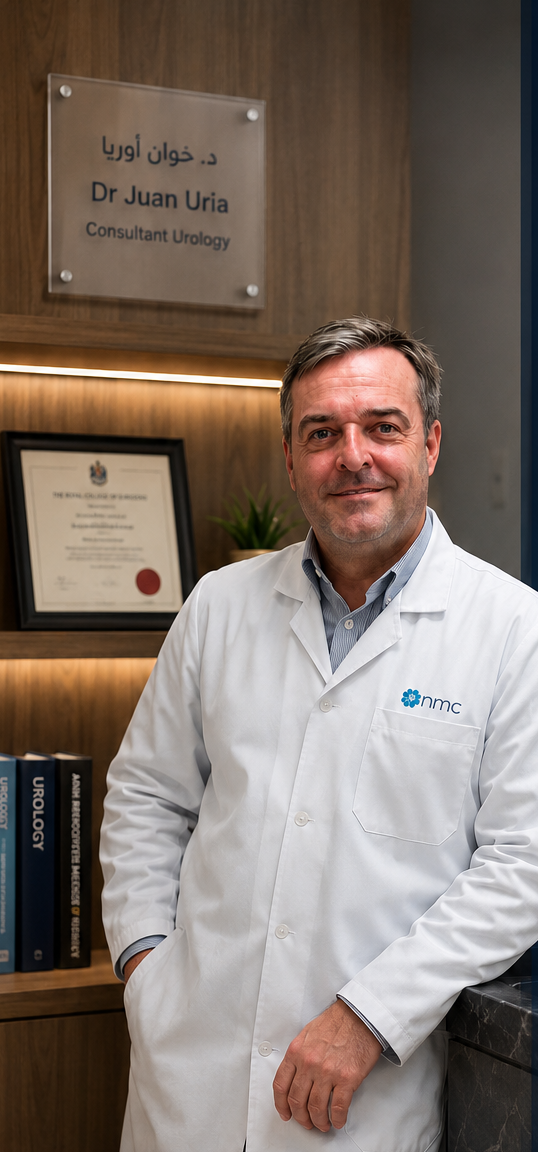
Dr. Juan Uría González-Tova · Consultant Urologist & Andrologist · NMC Royal Hospital Khalifa City, Abu Dhabi
Medically reviewed by Dr. Juan Uría · August 19, 2026
Take the self-assessmentTwo minutes. Nothing is sent or saved.Erectile function depends on the interaction of blood vessels, nerves, hormones and psychological state. Because the arteries of the penis are narrower than the coronary arteries, they tend to show the effects of vascular disease earlier. This is why erectile dysfunction is often described as an early warning marker: in a proportion of men it precedes the diagnosis of hypertension, diabetes or dyslipidaemia by several years.
Contributing factors are usually combined rather than single. Vascular and metabolic disease, low testosterone, medication side effects, tobacco and alcohol use, sleep disorders, anxiety and relationship stress all interact. Treating only the most obvious of these is the most common reason a man does not improve, and the reason assessment matters more than the prescription.
Check your own symptoms
Erectile function self-assessment (IIEF-5)
The five questions below are the IIEF-5 (also called the SHIM), the short form of the International Index of Erectile Function used in urology clinics worldwide.
Answer for the last six months. There is a sixth question after them that is not part of the score but matters clinically.
Question 1 of 6
Choose the closest answer
What the assessment involves
A first consultation is diagnostic before it is therapeutic. The aim is to identify what is actually driving the problem in this particular patient, and to rule out the systemic disease that erectile dysfunction can be signalling.
Clinical and sexual history, including onset, pattern and morning erections
Review of current medication, since several common drug classes contribute
Cardiovascular and metabolic screening: blood pressure, glucose, lipid profile
Hormone profile, including total testosterone measured in the morning
Physical examination, with penile Doppler ultrasound where vascular assessment is indicated
Treatment
Treatment begins with what the assessment found, not with a prescription. Where blood pressure, glucose, lipids, sleep apnoea or low testosterone are contributing, treating those improves erectile function on its own and protects against the cardiovascular events the symptom may be warning about. Where a medication is the cause — some antihypertensives, antidepressants and finasteride among them — changing it is often the whole treatment.
Oral PDE5 inhibitors are the established first-line medical treatment and work for most men, but a large share of those who believe they have failed have never taken them correctly. They need sexual stimulation to work, several of them are blunted by a heavy meal, the dose is often started too low, and each drug deserves four to six adequate attempts before it is called ineffective. They are absolutely contraindicated with nitrates. Where they genuinely do not work, intracavernosal injection therapy and vacuum devices are effective second-line options that are frequently dismissed before they have been properly taught.
Beyond that there are two distinct paths. Regenerative treatment — low-intensity shockwave therapy, with or without platelet-rich plasma — aims at the blood supply itself rather than at the moment, and suits men with mild to moderate vascular disease; the treatment pages for each set out honestly what the evidence supports. A penile implant is the definitive option where everything else has failed, and it has the highest satisfaction rates of any treatment for erectile dysfunction, which is worth knowing rather than reaching last and reluctantly.
Common questions
01Is erectile dysfunction a normal part of getting older?
Prevalence rises with age, but erectile dysfunction is not an inevitable consequence of ageing and it should not be accepted as one. In a substantial number of men it reflects a treatable vascular, hormonal or metabolic condition, so age alone is not a reason to leave it unassessed.
02Should I see a urologist or an andrologist?
Andrology is the subspecialty of urology dealing with male sexual and reproductive health, so an andrologist is a urologist with focused training in exactly this area. For erectile dysfunction, either can begin the assessment, but a urologist with andrology training is best placed to manage it through to treatment.
03Can I just buy tablets without seeing a doctor?
This is inadvisable on two counts. These medicines are contraindicated with nitrates and unsafe in some cardiac conditions, and self-medicating removes the opportunity to detect the underlying disease that the symptom may be pointing to. In the UAE they are prescription medicines and require medical assessment.
04Is the consultation confidential?
Yes. Consultations are covered by medical confidentiality and by UAE health data protection requirements, in the same way as any other medical consultation.
About Dr. Juan Uría
Dr. Juan Uría González-Tova is a Consultant Urologist and Andrologist at NMC Royal Hospital, Khalifa City, Abu Dhabi, with over 30 years of clinical practice. He gained his medical degree at the University of Oviedo and his PhD at the University of Barcelona, and has practised in Abu Dhabi since 2018. Consultations are held in English, Spanish or Catalan.
View Dr. Uría's official NMC profileBook a consultation
Consultations take place at NMC Royal Hospital, Khalifa City, Abu Dhabi, in English, Spanish or Catalan.
Related topics
Penile Doppler ultrasound
Penile implant surgery
Testosterone deficiency & TRT
Shockwave therapy (LI-ESWT)
This page is general medical information and does not replace individual medical advice, diagnosis or treatment. If you have symptoms, seek assessment from a licensed physician.