
Prostate Cancer Diagnosis and Treatment in Abu Dhabi
Prostate cancer is the most common cancer in men and, caught early, one of the most treatable. Most cases are found through a raised PSA in a man with no symptoms at all, which is why the decision that matters is not what to do about a diagnosis but whether to be tested in the first place — and that decision is worth making deliberately rather than by default.
- Confidential consultation
- Consultant Urologist & Andrologist
- NMC Royal Hospital, Abu Dhabi
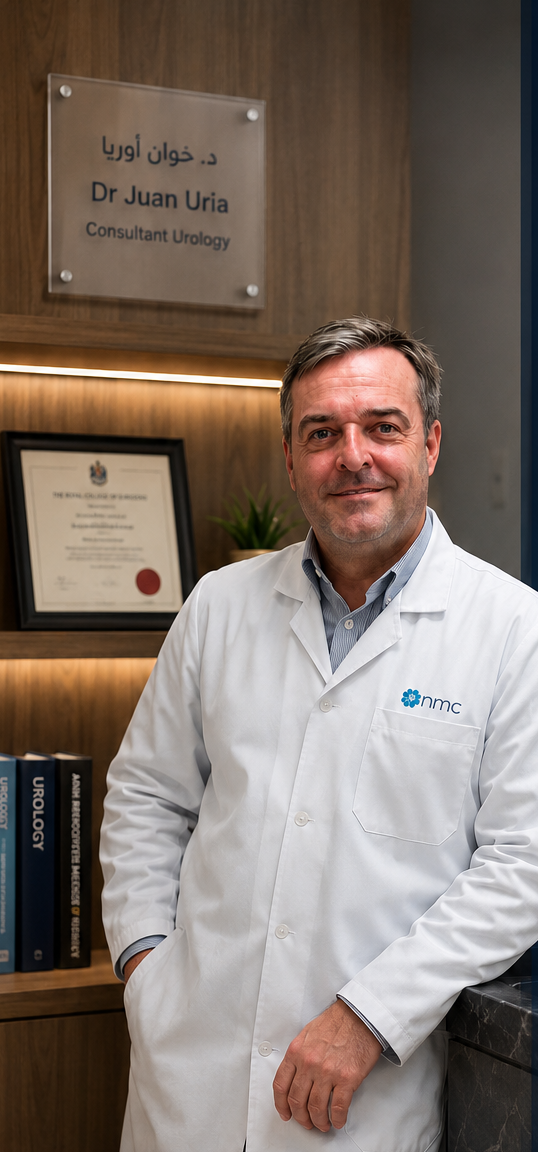
Dr. Juan Uría González-Tova · Consultant Urologist & Andrologist · NMC Royal Hospital Khalifa City, Abu Dhabi
Medically reviewed by Dr. Juan Uría · August 19, 2026
Take the self-assessmentTwo minutes. Nothing is sent or saved.A raised PSA is not a diagnosis of cancer. Benign enlargement, prostatitis, urinary infection, recent ejaculation and even cycling all raise it, and a large proportion of men with an elevated result do not have cancer. The value of the test lies in what is done next: interpreting the figure in context, repeating it where a reversible cause is present, and investigating further only when the picture justifies it.
The pathway has changed considerably. Multiparametric MRI before biopsy now identifies which men need one at all and where to target it, which spares a proportion of men an unnecessary procedure and improves the accuracy of the rest. Where cancer is confirmed, it is graded and staged, and slow-growing disease is often best served by active surveillance rather than immediate treatment — a real option, not a euphemism for doing nothing, and one that avoids the side effects of treatment in men who would never have been harmed by the disease.
Check your own symptoms
Prostate cancer risk check
A structured risk screen written for this page, built from the risk factors that guidelines use to decide when PSA testing should start. No questionnaire detects prostate cancer — early prostate cancer produces no symptoms at all, which is the single most important fact on this page.
This works out whether and when you should be having a PSA test. It cannot tell you whether you have prostate cancer, and neither can your symptoms — only a blood test, an examination and, where indicated, an MRI can begin to.
Question 1 of 5
Choose the closest answer
What the assessment involves
The first consultation is about deciding, together, whether and how to investigate. Testing without that conversation is what leads to over-treatment; not testing at all is what leads to disease found late.
Personal and family history, including relatives with prostate or breast cancer, which changes both the age to start and the threshold to act
Urinary symptoms and digital rectal examination, which give information the PSA does not
PSA interpreted in context — age, prostate volume, previous values and rate of change — rather than against a single cut-off
Multiparametric MRI where biopsy is being considered, so that a biopsy is targeted or avoided rather than performed blind
A frank discussion of what a diagnosis would mean, including active surveillance, before any test is done
Treatment
The most important thing to say about treatment is that for localised disease the survival figures are reassuring and very similar across the options. In the ProtecT trial, which randomised men with PSA-detected localised cancer to active monitoring, surgery or radiotherapy, prostate-cancer mortality at a median fifteen years was around three per cent in every group. What differed was not survival but side effects and the risk of the disease spreading — which reframes the decision from 'which treatment saves my life' to 'which set of trade-offs do I prefer'.
Active surveillance is the right answer for low-risk disease and is not a lesser option. It means regular PSA, examination, MRI and repeat biopsy where indicated, with radical treatment held in reserve for signs of progression — and a substantial proportion of men on surveillance never need it. The trade-off is honest: monitoring avoids the side effects of treatment, and in ProtecT it carried a higher rate of the cancer spreading than immediate treatment did, without a difference in death from the disease at fifteen years.
Where radical treatment is chosen, the two options differ mainly in the shape of their side effects. Surgery removes the prostate — laparoscopically here — and produces the greatest early impact on continence and erections, with recovery over the following months and nerve-sparing technique used wherever the cancer allows. Radiotherapy, often with a period of hormone therapy, avoids an operation and preserves continence better early on, but affects bowel function more and its sexual side effects accumulate later. The patient-reported outcomes from ProtecT set this out in detail, and they are the right basis for the conversation rather than a general reassurance.
Evidence
Read the clinical guidance and published evidence behind this page.
- Hamdy FC, et al. Fifteen-Year Outcomes after Monitoring, Surgery, or Radiotherapy for Prostate Cancer. N Engl J Med. 2023;388(17):1547–1558. doi:10.1056/NEJMoa2214122
- Donovan JL, et al. Patient-Reported Outcomes after Monitoring, Surgery, or Radiotherapy for Prostate Cancer. N Engl J Med. 2016;375(15):1425–1437. doi:10.1056/NEJMoa1606221
Common questions
01At what age should I start PSA testing?
For most men the conversation begins around 50. It begins earlier, commonly at 45 or even 40, for men with a father or brother diagnosed with prostate cancer, men of African ancestry, and men carrying BRCA mutations. The right answer depends on your own risk and on how you would want a diagnosis handled, which is why it is a discussion rather than a fixed number.
02My PSA is high. Does that mean I have cancer?
Usually not. Benign enlargement is the commonest explanation, and infection, inflammation, recent ejaculation and cycling all raise it temporarily. The next step is not a biopsy but proper interpretation: examination, repeating the test once any reversible cause has been dealt with, and imaging if the picture still warrants it.
03Is every prostate cancer treated?
No, and that is a considered decision rather than a compromise. Low-grade, low-volume disease frequently grows so slowly that it would never cause harm in a man's lifetime, and treating it would impose side effects for no benefit. Such cases are followed with active surveillance — regular PSA, examination, imaging and repeat biopsy where indicated — with treatment held in reserve for signs of progression.
04Will treatment affect continence and erections?
Both are recognised risks of radical treatment, and both deserve to be discussed in specifics — expected rates, how long recovery usually takes, and what can be done about each — before a treatment is chosen rather than after. Nerve-sparing technique, the stage of the disease and function before surgery all influence the outcome, and rehabilitation is part of the plan, not an afterthought.
About Dr. Juan Uría
Dr. Juan Uría González-Tova is a Consultant Urologist and Andrologist at NMC Royal Hospital, Khalifa City, Abu Dhabi, with over 30 years of clinical practice. He gained his medical degree at the University of Oviedo and his PhD at the University of Barcelona, and has practised in Abu Dhabi since 2018. Consultations are held in English, Spanish or Catalan.
View Dr. Uría's official NMC profileBook a consultation
Consultations take place at NMC Royal Hospital, Khalifa City, Abu Dhabi, in English, Spanish or Catalan.
Related topics
This page is general medical information and does not replace individual medical advice, diagnosis or treatment. If you have symptoms, seek assessment from a licensed physician.