Peyronie's Disease Specialist in Abu Dhabi
Peyronie's disease is the formation of fibrous scar tissue in the penis, producing curvature, deformity, shortening and often pain. It is a recognised medical condition, not a cosmetic complaint, and the timing of assessment matters: the treatment options available differ substantially between the active early phase and the stable later phase.
- Confidential consultation
- Consultant Urologist & Andrologist
- NMC Royal Hospital, Abu Dhabi
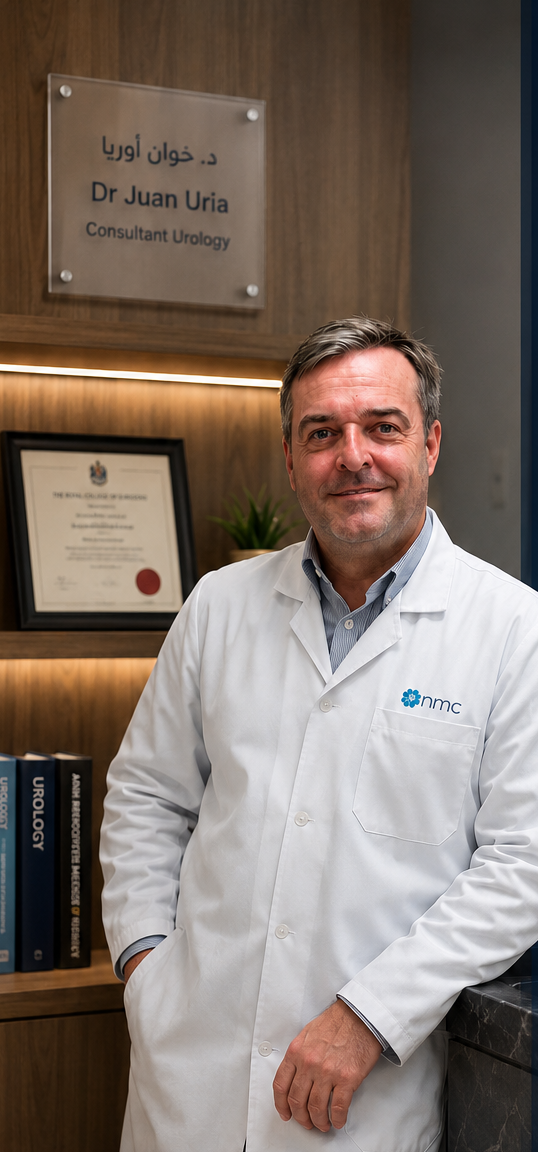
Dr. Juan Uría González-Tova · Consultant Urologist & Andrologist · NMC Royal Hospital Khalifa City, Abu Dhabi
Medically reviewed by Dr. Juan Uría · August 19, 2026
Take the self-assessmentTwo minutes. Nothing is sent or saved.The condition typically runs in two phases. In the active phase, over roughly the first six to eighteen months, the curvature changes and pain is common. In the stable phase that follows, pain usually settles and the deformity stops progressing. Which phase a patient is in determines what can usefully be offered, so establishing this is the first step of any assessment.
Peyronie's disease is more common than its low consultation rate suggests, and it is associated with diabetes, Dupuytren's contracture and previous penile trauma, which may be minor and unremembered. Erectile dysfunction coexists in a significant proportion of patients, and whether it is present changes the treatment decision, so the two are always assessed together.
Check your own symptoms
Penile curvature self-assessment
There is no single validated patient questionnaire for Peyronie's disease. The questions below are a structured clinical screen: they follow the history taken in consultation, covering the three things that decide management — how far the disease has progressed, how much curvature there is, and how much it is interfering.
Answer about the last three months. Photographs of the erect penis from above and from the side are worth taking before your appointment — they are more reliable than memory and they are what the assessment will be based on.
Question 1 of 7
Choose the closest answer
What the assessment involves
Assessment establishes three things: how much deformity there is and in which direction, whether the disease is still active or has stabilised, and whether erectile function is preserved. Every treatment decision follows from those three answers.
History of onset, progression, pain and any precipitating event
Examination of the plaque: position, size and consistency
Objective measurement of the curvature angle, rather than estimation
Penile Doppler ultrasound to assess plaque, calcification and blood flow
Assessment of erectile function, since it determines which options apply
Treatment
The first decision is which phase the disease is in, because it dictates everything else. In the active phase — pain, changing curvature, usually the first six to eighteen months — the aim is to control symptoms and let the disease stabilise, and surgery is not performed on a deformity that is still moving. In the stable phase, with curvature unchanged for at least three months and no pain, correction becomes possible.
Non-surgical treatment is worth being straightforward about: oral agents have a poor record and are not a substitute for a plan. Mechanical traction has the best evidence among conservative measures for curvature and length, but it demands real daily commitment over months to achieve a modest gain. Intralesional injection — collagenase where available, or verapamil — can reduce curvature in selected men with a discrete plaque and no calcification, and it is a course of treatment rather than a single visit.
Surgery is the reliable correction, and the choice among three operations follows the anatomy and the erection. Plication shortens the longer side: it is simpler, predictable, and costs some length. Plaque incision with grafting preserves length and suits severe curvature or an hourglass deformity, but carries a higher risk to erectile function. Where significant erectile dysfunction accompanies the curvature, a penile implant corrects both in one operation and is the better answer than treating them separately.
Common questions
01Will Peyronie's disease resolve on its own?
Spontaneous complete resolution is uncommon. In most men the curvature stabilises rather than disappears, and in a minority it worsens. Pain frequently improves with time even when the deformity does not, so pain settling should not be read as the disease having resolved.
02When is the right time to see a specialist?
Early. Some options are only relevant during the active phase, and being assessed early means the phase is documented rather than reconstructed from memory later. Waiting for the curvature to stabilise before seeking any advice removes choices rather than preserving them.
03Does every case need surgery?
No. Surgery is generally considered for stable disease where the deformity prevents intercourse or is severe, and several non-surgical options exist. The decision depends on the degree of curvature, whether the disease is stable, erectile function and the patient's own priorities.
About Dr. Juan Uría
Dr. Juan Uría González-Tova is a Consultant Urologist and Andrologist at NMC Royal Hospital, Khalifa City, Abu Dhabi, with over 30 years of clinical practice. He gained his medical degree at the University of Oviedo and his PhD at the University of Barcelona, and has practised in Abu Dhabi since 2018. Consultations are held in English, Spanish or Catalan.
View Dr. Uría's official NMC profileBook a consultation
Consultations take place at NMC Royal Hospital, Khalifa City, Abu Dhabi, in English, Spanish or Catalan.
Related topics
This page is general medical information and does not replace individual medical advice, diagnosis or treatment. If you have symptoms, seek assessment from a licensed physician.