Laparoscopic Urological Surgery in Abu Dhabi
Laparoscopic surgery reaches the kidney, prostate or bladder through several small incisions instead of one long one. The operation performed inside is the same operation; what changes is the trauma of getting there — less blood loss, less pain, a shorter stay and a faster return to normal activity. What it does not change is that the decision to operate has to be right in the first place.
- Confidential consultation
- Consultant Urologist & Andrologist
- NMC Royal Hospital, Abu Dhabi
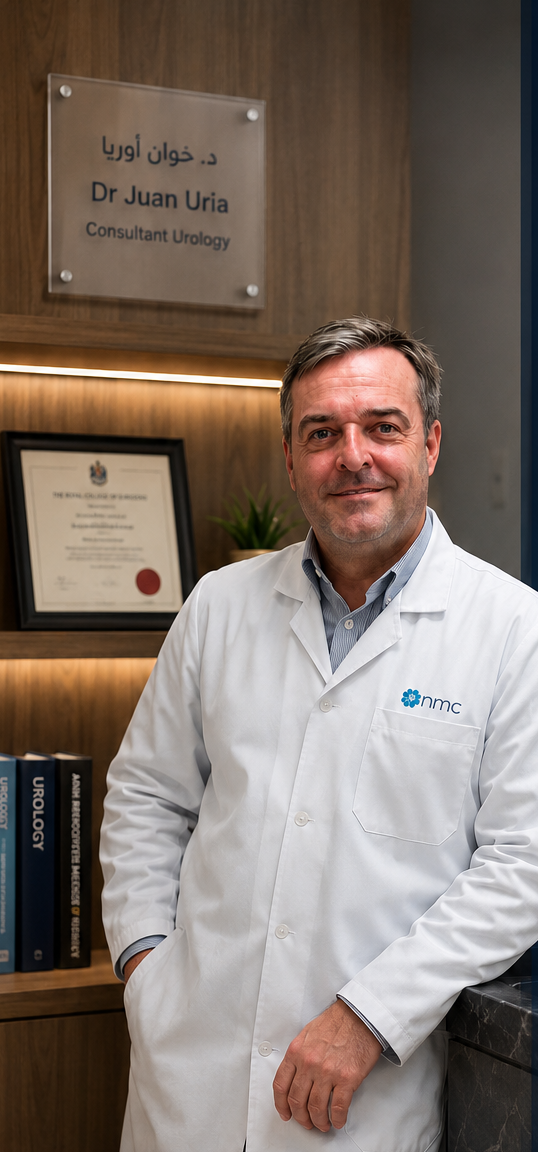
Dr. Juan Uría González-Tova · Consultant Urologist & Andrologist · NMC Royal Hospital Khalifa City, Abu Dhabi
Medically reviewed by Dr. Juan Uría · August 19, 2026
Take the self-assessmentTwo minutes. Nothing is sent or saved.In urology the approach is used for radical prostatectomy in localised prostate cancer, for removing a kidney or part of one in kidney cancer, and for removing the bladder in muscle-invasive disease. Partial nephrectomy is the clearest illustration of what the technique is for: removing the tumour and preserving functioning kidney tissue is technically harder than removing the whole kidney, and it is worth the difficulty because kidney function preserved is kidney function that never has to be replaced.
Not every patient is a candidate, and saying so is part of the assessment. Extensive previous abdominal surgery, certain tumour positions and some cardiorespiratory conditions can make an open approach the safer choice, and a laparoscopic operation may need to be converted to an open one during surgery — which is a judgement made for safety, not a complication. The cancer outcome always outranks the size of the incision.
Check your own symptoms
Minimally invasive surgery readiness check
A structured pre-operative screen written for this page. It follows the questions asked at a surgical planning consultation, and it is here to help you arrive at that consultation with the right information rather than to decide anything on its own.
Whether an operation can be done laparoscopically depends on the disease, on your previous surgery, and on your fitness for a longer anaesthetic. These questions cover all three.
Question 1 of 6
Choose the closest answer
What the assessment involves
Surgical planning is specific to the patient and the tumour. The assessment establishes that surgery is the right treatment, that this approach is the right way to deliver it, and that the patient is fit for it.
Cross-sectional imaging to define the tumour, its relationship to blood vessels and the collecting system, and the surgical plan that follows
Baseline kidney function, which decides how much weight to give to preserving tissue
Record of previous abdominal surgery and adhesions, which influence whether the approach is feasible
Anaesthetic and cardiorespiratory fitness assessment, since laparoscopy involves positioning and abdominal pressure that some patients tolerate poorly
A clear account of the expected recovery, the functional risks specific to the operation, and the possibility of conversion to open surgery
Treatment
Preparation is part of the operation. Anticoagulants and antiplatelet agents are stopped or bridged to a plan agreed with the prescribing physician; smoking stopped several weeks beforehand measurably reduces wound and chest complications; diabetes and blood pressure are optimised; and anaemia is corrected in advance rather than transfused during. Where the patient is deconditioned and the operation can wait, a few weeks of preparation buys a better recovery than any refinement of technique.
The operation is performed through several small incisions with the abdomen insufflated, which is what allows the magnified view and the reduced trauma. In radical prostatectomy the prostate and seminal vesicles are removed and the bladder rejoined to the urethra, with the nerve bundles preserved wherever the cancer permits — that decision is made from the imaging and the biopsy beforehand, and it is never allowed to compromise the cancer margin. In partial nephrectomy the tumour is excised with a margin and the kidney reconstructed, working within a limited period of controlled blood flow interruption.
Recovery follows an enhanced-recovery pattern: eating and walking the same day or the next, most patients home within one to three days depending on the operation, and light activity within a couple of weeks with heavy lifting deferred for six. After prostatectomy a catheter stays for one to two weeks, pelvic floor exercises begin as soon as it is removed, and continence and erectile function recover over months rather than days — rehabilitation for both starts early and is part of the plan, not something arranged if problems appear. Follow-up is scheduled before discharge, with PSA or imaging at defined intervals depending on what was treated.
Common questions
01Is laparoscopic surgery as effective as open surgery for cancer?
For the operations where it is established in urology, the cancer outcomes are comparable — the same tissue is removed, with the same margins, by a different route. The benefit is in recovery rather than in cure rates. If a tumour's position or extent meant that an open approach would give a better cancer result, that is the approach that should be used.
02How long is the recovery?
It depends on the operation, but the pattern is consistent: a shorter hospital stay than the open equivalent, less need for strong pain relief, and a return to light activity within a couple of weeks. Heavy lifting and strenuous exercise wait longer. You will be given the timeline for your specific operation before you consent to it, not after.
03Can the whole kidney be saved if I have a tumour?
Often, part of it can. Where the tumour is small and favourably placed, partial nephrectomy removes the tumour with a margin and leaves the rest of the kidney working. This matters most in people with reduced function, a single kidney, diabetes or hypertension, where preserving tissue protects against future kidney failure. Position and size decide whether it is possible, and imaging answers that before surgery.
04What if the operation has to be converted to open surgery?
It is discussed and consented to in advance because it is a recognised possibility, not an unexpected one. Bleeding, dense adhesions or anatomy that turns out to differ from the imaging are the usual reasons. Converting is a decision taken to keep the operation safe and complete, and it should be understood as good surgical judgement rather than as something having gone wrong.
About Dr. Juan Uría
Dr. Juan Uría González-Tova is a Consultant Urologist and Andrologist at NMC Royal Hospital, Khalifa City, Abu Dhabi, with over 30 years of clinical practice. He gained his medical degree at the University of Oviedo and his PhD at the University of Barcelona, and has practised in Abu Dhabi since 2018. Consultations are held in English, Spanish or Catalan.
View Dr. Uría's official NMC profileBook a consultation
Consultations take place at NMC Royal Hospital, Khalifa City, Abu Dhabi, in English, Spanish or Catalan.
Related topics
This page is general medical information and does not replace individual medical advice, diagnosis or treatment. If you have symptoms, seek assessment from a licensed physician.