Penile Implant Surgery in Abu Dhabi
A penile implant is a surgically placed device that provides rigidity for sexual intercourse when other erectile dysfunction treatments have failed or are unsuitable. Cylinders sit within the erectile chambers of the penis. The procedure changes the natural erectile mechanism permanently: removing the device does not restore the erections a man had before surgery.
- Confidential consultation
- Consultant Urologist & Andrologist
- NMC Royal Hospital, Abu Dhabi
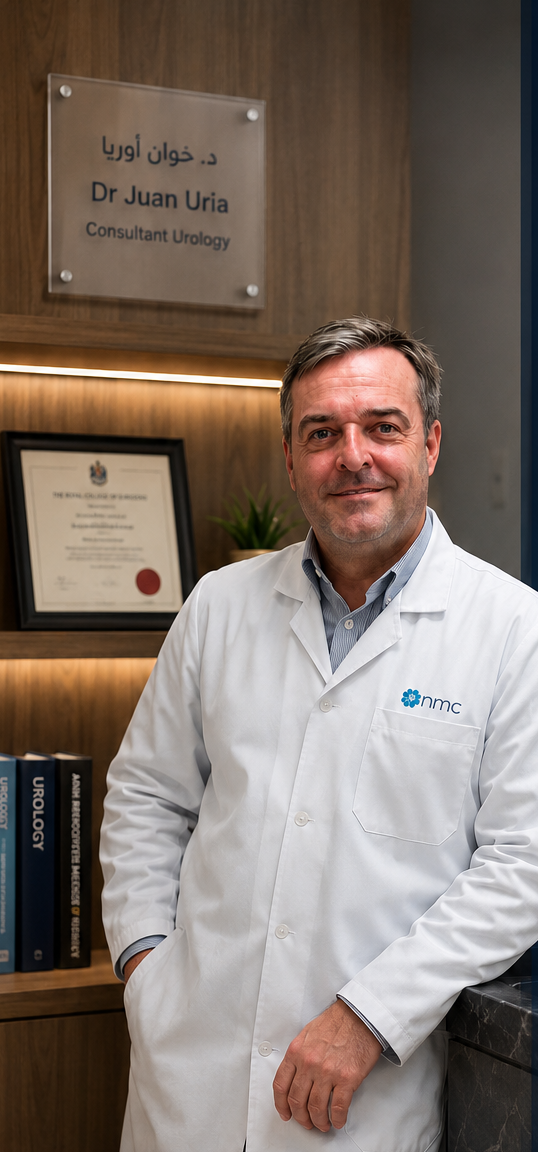
Dr. Juan Uría González-Tova · Consultant Urologist & Andrologist · NMC Royal Hospital Khalifa City, Abu Dhabi
Medically reviewed by Dr. Juan Uría · October 2, 2026
Content updated ·
Take the self-assessmentTwo minutes. Nothing is sent or saved.Two broad types exist. Malleable implants are bent into position by hand and are mechanically simpler. Inflatable implants use a pump to produce an erection closer to the natural state and are the more commonly chosen. The right choice depends on anatomy, manual dexterity, previous surgery and what the patient values most.
Implant surgery is usually reserved for specific situations: erectile dysfunction that has not responded to medication, severe Peyronie's disease with erectile failure, and post-surgical or diabetic erectile dysfunction where the tissue itself is compromised. The candidacy conversation is as important as the operation, because the decision cannot be undone afterwards.
Check your own symptoms
Penile implant candidacy check
A structured candidacy screen written for this page, following the criteria used in andrology practice. There is no validated patient questionnaire for implant selection — the decision is made in consultation, and this only tells you whether that conversation is worth having yet.
An implant is considered when other treatments have genuinely been tried and have genuinely failed. These questions establish where you are on that path.
Question 1 of 7
Choose the closest answer
What the assessment involves
The consultation reviews previous treatment, suitable alternatives and your goals. Not every patient needs to try every option, but the permanent changes, benefits and risks must be understood before choosing surgery.
Documented history of previous erectile dysfunction treatments and their outcomes
Vascular assessment and examination of penile anatomy and any fibrosis
Glycaemic control and infection risk review, both of which affect implant outcomes
Discussion of implant type, and of partner expectations where relevant
Explicit consent conversation covering irreversibility, revision surgery and device lifespan
Treatment
Choosing surgery is a shared decision. Tablets, injections and vacuum devices are discussed alongside an implant, taking account of effectiveness, tolerability and patient preference. Diabetes or previous prostate surgery alone does not make an implant necessary. Bring previous treatment details and any Doppler results to your consultation at NMC Royal Hospital Khalifa City.
Device choice depends on your needs. Inflatable implants use a scrotal pump; a three-piece device also has a fluid reservoir. Malleable rods remain firm and are positioned by hand, making operation simpler but concealment less natural. Hand function, anatomy and previous surgery matter. Confirm the specific model available and practise using a demonstration device before deciding.
Set realistic expectations before consent. An implant provides rigidity; it is not a lengthening procedure and does not treat low desire. Infection, erosion or mechanical failure may require another operation, including removal or replacement. Published results cannot predict an individual outcome. Ask about your surgeon’s experience, personal complication data and the plan if a problem occurs.
Recovery includes wound review and device training. Bruising and swelling are expected early on. The surgical team sets the timing for activation, work, exercise and sex according to healing and the device. Do not start inflating the implant yourself before being taught. Arrange follow-up and an urgent contact number before leaving hospital.
Evidence
Read the clinical guidance and published evidence behind this page.
- European Association of Urology. Sexual and Reproductive Health: management of erectile dysfunction, penile prostheses. Read source
- British Association of Urological Surgeons. Penile prostheses: patient information. Read source
- University College London Hospitals NHS Foundation Trust. Insertion of inflatable penile prosthesis: recovery and aftercare. Read source
Common questions
01Is a penile implant reversible?
It should be considered irreversible. The cylinders occupy surgically prepared spaces within the corpora cavernosa and replace their rigidity mechanism. Removal does not restore preoperative erectile function. This is different from simply removing all penile tissue.
02Will it be visible or obvious to others?
The device is placed entirely inside the body and is not externally visible. Inflatable implants leave the penis in its normal flaccid state when not in use. Appearance in clothing is not altered.
03Does an implant affect sensation, orgasm or ejaculation?
The implant restores rigidity, which is a mechanical function. Sensation, orgasm and ejaculation depend on nerves and structures the device does not replace and are generally unchanged by the implant itself, although they may already be affected by the underlying condition.
04When can I have sex after an implant?
Patient guidance commonly advises waiting around four to six weeks, but your surgeon must confirm healing and teach you how to use the device before you resume sex. Follow your own discharge plan rather than a fixed date from a website.
05Which symptoms need urgent review after surgery?
Contact the surgical team urgently for fever, increasing redness, wound discharge, persistent bleeding or pain not controlled by prescribed medication. If the team is unavailable, seek urgent medical care rather than waiting for a routine appointment.
06How much does penile implant surgery cost in Abu Dhabi?
Request an individual written estimate from NMC after assessment. Ask whether it includes the implant, surgeon, anaesthesia, hospital stay and follow-up. Device availability and insurance approval must be confirmed by the hospital; this website does not quote a package price.
About Dr. Juan Uría
Dr. Juan Uría González-Tova is a Consultant Urologist and Andrologist at NMC Royal Hospital, Khalifa City, Abu Dhabi, with over 30 years of clinical practice. He gained his medical degree at the University of Oviedo and his PhD at the University of Barcelona, and has practised in Abu Dhabi since 2018. Consultations are held in English, Spanish or Catalan.
View Dr. Uría's official NMC profileBook a consultation
Consultations take place at NMC Royal Hospital, Khalifa City, Abu Dhabi, in English, Spanish or Catalan.
Related topics
This page is general medical information and does not replace individual medical advice, diagnosis or treatment. If you have symptoms, seek assessment from a licensed physician.