Shockwave Therapy for Erectile Dysfunction in Abu Dhabi
Low-intensity extracorporeal shockwave therapy applies acoustic pulses to the erectile tissue with the aim of improving penile blood flow. Of the regenerative options offered for erectile dysfunction it is the one with the most clinical evidence behind it, and European guidance recognises it as an option in mild vasculogenic erectile dysfunction — but the effect is moderate, it is not permanent, and it does not replace finding out why the erectile dysfunction is there.
- Confidential consultation
- Consultant Urologist & Andrologist
- NMC Royal Hospital, Abu Dhabi
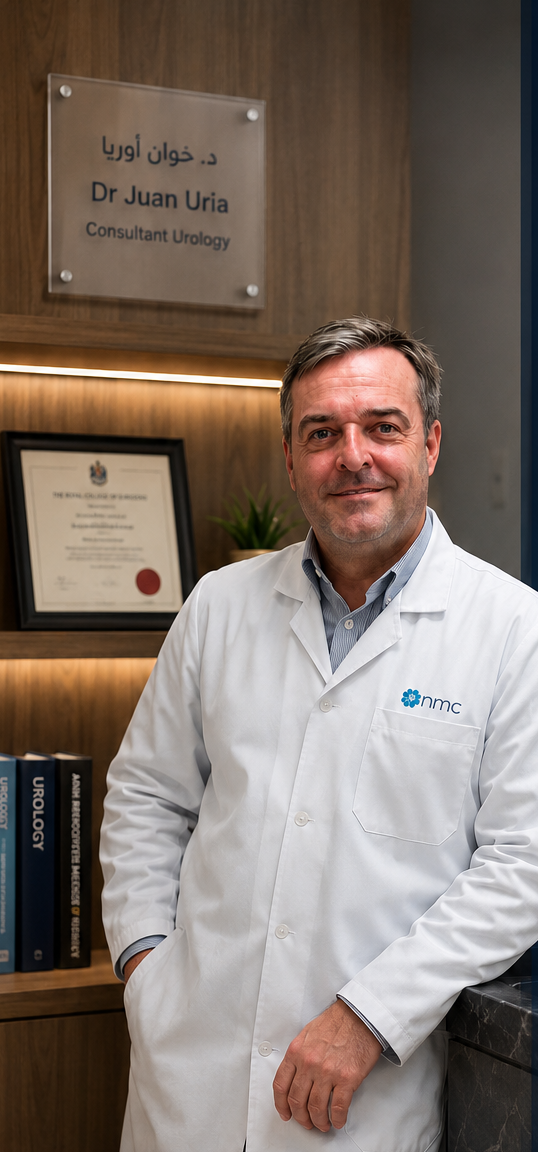
Dr. Juan Uría González-Tova · Consultant Urologist & Andrologist · NMC Royal Hospital Khalifa City, Abu Dhabi
Medically reviewed by Dr. Juan Uría · August 19, 2026
Take the self-assessmentTwo minutes. Nothing is sent or saved.The rationale is vascular. The pulses are delivered at an energy far below that used to fragment kidney stones, and the intention is to stimulate the endothelium of the small penile arteries rather than to destroy tissue. This is also why patient selection decides the result: the men who benefit most are those with mild vasculogenic erectile dysfunction and preserved response to oral medication, while benefit is limited where the mechanism is different — severe arterial disease, poorly controlled diabetes of long standing, or nerve injury following pelvic surgery.
The evidence deserves to be described accurately rather than favourably. European Association of Urology guidance places it among the options for mild vasculogenic erectile dysfunction; the American Urological Association still classifies it as investigational. Both positions are defensible, because trials differ in the device used, the energy delivered, the number of sessions and the length of follow-up, and those differences are large enough that results from one protocol do not transfer to another. What follows for the patient is practical: a course of shockwave therapy is a reasonable option to discuss in the right clinical situation, and it is not a guaranteed outcome. It also appears to work better in company than alone — a 2025 meta-analysis of seven randomised trials found that adding platelet-rich plasma to shockwave improved erectile function scores significantly more than shockwave by itself.
Check your own symptoms
Shockwave therapy suitability check
A structured suitability screen written for this page. Low-intensity shockwave therapy has published trials but no validated patient selection questionnaire, so these questions follow the inclusion criteria those trials actually used — which is where the honest version of "am I a candidate?" comes from.
The benefit shown in trials is real but modest, and it is concentrated in one specific group: men with mild-to-moderate erectile dysfunction of vascular origin who still respond, at least partly, to tablets. These questions work out how close you are to that group.
Question 1 of 6
Choose the closest answer
What the assessment involves
Shockwave therapy is a treatment decision, not an entry point. The assessment exists to establish that the erectile dysfunction is vascular in origin, that nothing more serious is being missed, and that this particular patient belongs to the group in which the treatment has been shown to help.
Severity and pattern of the erectile dysfunction, recorded with a validated score such as the IIEF-5 so that any change can be measured afterwards
Cardiovascular and metabolic screening, since erectile dysfunction can be the presenting sign of undiagnosed vascular disease
Hormone profile and review of current medication, both of which can account for the symptom on their own
Penile Doppler ultrasound where the vascular contribution needs to be confirmed rather than assumed
An explicit conversation about expected benefit, the alternatives with longer evidence behind them, and what happens if the course does not work
Treatment
A course is delivered as a defined protocol, not as individual sessions bought one at a time. Sessions are given weekly or twice weekly over several weeks; each takes about twenty minutes, needs no anaesthetic, and normal activity including sex resumes the same day. The energy setting and the number of shocks per site follow the protocol the evidence was generated with — this is the variable that differs most between clinics, and it is the reason results differ between them.
The result is measured, not asked about. An IIEF-5 score is recorded before starting and repeated at twelve weeks, because memory is an unreliable instrument for judging a gradual change and because a course that has not worked should be identified as such rather than extended. Where the assessment showed a vascular mechanism and the response is partial, adding platelet-rich plasma to the course has better evidence than shockwave alone; where the response is absent, the answer is to revisit the diagnosis, not to sell more sessions.
Shockwave is given alongside the rest of the plan rather than in place of it. Oral medication is usually continued during the course, and many men find it works better afterwards even where spontaneous erections have not returned — that is a legitimate result, not a failure. The vascular risk factors that produced the problem continue regardless of the treatment, so blood pressure, glucose, lipids, weight, smoking and sleep are managed in parallel; they determine how long any gain lasts.
Evidence
Read the clinical guidance and published evidence behind this page.
- Zhou Z, et al. The efficacy of platelet-rich plasma (PRP) alone or in combination with low intensity shock wave therapy (Li-SWT) in treating erectile dysfunction: a systematic review and meta-analysis of seven randomized controlled trials. Aging Male. 2025;28(1):2472786. doi:10.1080/13685538.2025.2472786
Common questions
01How well does shockwave therapy actually work?
In mild vasculogenic erectile dysfunction, trials report an average improvement that is real but moderate, and a proportion of men do not respond at all. It is more accurate to think of it as improving the underlying blood supply — sometimes enough to restore spontaneous erections, more often enough to make oral medication work better — than as a cure. Any clinic presenting it as a guaranteed or permanent solution is overstating the evidence.
02Is it painful, and is there any recovery time?
The energy used is low and the sessions are generally described as uncomfortable rather than painful. No anaesthetic is required, sessions last a matter of minutes, and normal activity — including sexual activity — can be resumed the same day. A course is typically delivered over several weeks rather than in a single visit.
03If it works, will the improvement last?
Follow-up in most published studies runs to twelve months or less, so durability beyond that is genuinely not well established. Improvement tends to fade over time in a proportion of men, and repeat courses are sometimes given. Since the underlying vascular disease continues regardless, the factors that caused it — blood pressure, glucose, lipids, smoking, weight, sleep — matter more to the long-term result than the number of sessions.
04Who should not have it?
It is not the right treatment where the erectile dysfunction is predominantly hormonal, psychological or neurological, because the mechanism it addresses is not the one causing the problem. It is also not appropriate as a first step when the assessment has not been done: erectile dysfunction can be the first sign of cardiovascular disease, and treating the symptom while leaving that unexamined is the one outcome worth avoiding.
About Dr. Juan Uría
Dr. Juan Uría González-Tova is a Consultant Urologist and Andrologist at NMC Royal Hospital, Khalifa City, Abu Dhabi, with over 30 years of clinical practice. He gained his medical degree at the University of Oviedo and his PhD at the University of Barcelona, and has practised in Abu Dhabi since 2018. Consultations are held in English, Spanish or Catalan.
View Dr. Uría's official NMC profileBook a consultation
Consultations take place at NMC Royal Hospital, Khalifa City, Abu Dhabi, in English, Spanish or Catalan.
Related topics
This page is general medical information and does not replace individual medical advice, diagnosis or treatment. If you have symptoms, seek assessment from a licensed physician.