
Prostate Specialist in Abu Dhabi — Enlarged Prostate & PSA
Benign prostatic hyperplasia is a non-cancerous enlargement of the prostate that becomes common from around age 50 and causes urinary symptoms: a weak stream, hesitancy, incomplete emptying and waking at night to urinate. It is not prostate cancer, but the two can produce similar symptoms, which is why the assessment must distinguish them rather than reassure prematurely.
- Confidential consultation
- Consultant Urologist & Andrologist
- NMC Royal Hospital, Abu Dhabi
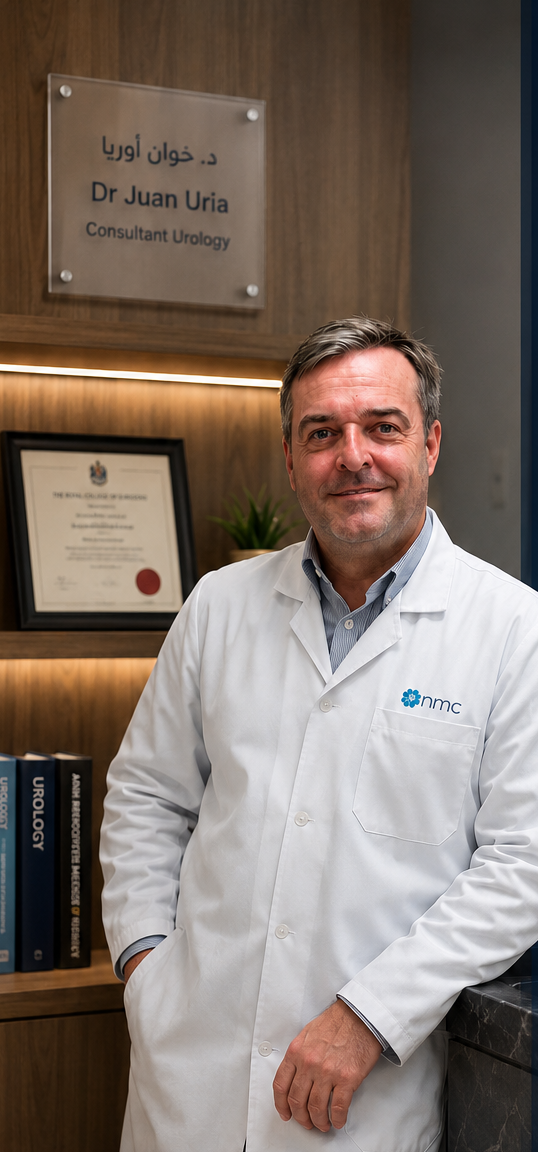
Dr. Juan Uría González-Tova · Consultant Urologist & Andrologist · NMC Royal Hospital Khalifa City, Abu Dhabi
Medically reviewed by Dr. Juan Uría · August 19, 2026
Take the self-assessmentTwo minutes. Nothing is sent or saved.Two things are commonly misunderstood. Prostate size correlates poorly with symptom severity — a moderately enlarged prostate can cause considerable difficulty while a large one causes little. And early prostate cancer typically causes no symptoms at all, so the absence of urinary complaints is not evidence that the prostate is healthy.
PSA is a useful test that is frequently over-interpreted in both directions. It rises with benign enlargement, infection, recent ejaculation and cycling, as well as with cancer, so a single raised value is a reason to investigate rather than a diagnosis. Interpreting it correctly means reading it alongside examination, prostate volume, the trend over time and individual risk.
Check your own symptoms
Prostate symptom score (IPSS)
These are the seven questions of the International Prostate Symptom Score (IPSS), the instrument used worldwide to grade the symptoms of benign prostatic enlargement and to measure whether treatment has helped.
Answer for the last month. Keep your score: repeating the IPSS after treatment is how you and your urologist tell whether anything actually changed, rather than relying on impression.
Question 1 of 9
Choose the closest answer
What the assessment involves
The assessment quantifies the symptoms, measures how well the bladder is emptying, and separates benign enlargement from the findings that require further investigation.
Structured symptom scoring, so that change over time can be measured rather than recalled
Urine flow measurement and post-void residual volume by ultrasound
Digital rectal examination and prostate volume assessment
PSA interpreted in context, including trend where previous values exist
Urinalysis and renal function, with imaging where obstruction is suspected
Treatment
Not every enlarged prostate needs treating. Where symptoms are mild and not bothersome, watchful waiting with simple measures is a legitimate plan: reducing evening fluids, caffeine and alcohol, reviewing diuretics and decongestants, and treating constipation resolve a surprising share of complaints. What is not acceptable is leaving retention, recurrent infection, bladder stones, blood in the urine or deteriorating kidney function to be managed by lifestyle — those are indications to intervene.
Medical treatment has two mechanisms and they are not interchangeable. Alpha blockers relax the prostate and bladder neck and work within days, which suits men who want relief quickly; they can cause dizziness and retrograde ejaculation, and the surgeon must be told about them before cataract surgery. 5-alpha reductase inhibitors shrink the gland over three to six months and are the ones that actually reduce the risk of retention and future surgery, but they cause sexual side effects in a minority and halve the PSA, which must be accounted for when interpreting it. In larger glands the two together outperform either alone, and tadalafil is an option where erectile dysfunction coexists.
Surgery is for men who do not improve on medication, who do not want to take it indefinitely, or who have the complications listed above. TURP remains the reference operation and is well suited to moderate glands. Holmium laser enucleation removes the whole adenoma regardless of size, and in a meta-analysis of thirteen randomised trials gave equivalent symptom relief to TURP with a shorter catheter time, a shorter stay, a smaller drop in haemoglobin and significantly fewer transfusions, at the cost of a longer operation. GreenLight vaporisation is particularly useful in men who cannot safely stop anticoagulation. All of these commonly cause retrograde ejaculation, which is worth understanding before the operation rather than discovering after it.
Evidence
Read the clinical guidance and published evidence behind this page.
- Daryanto B, et al. Holmium laser enucleation of the prostate versus transurethral resection of the prostate in treatment of benign prostatic hyperplasia: a meta-analysis of 13 randomized control trials. Curr Urol. 2024;19(1):6–16. doi:10.1097/CU9.0000000000000257
Common questions
01Does an enlarged prostate mean I have cancer?
No. Benign prostatic hyperplasia and prostate cancer are different conditions, and enlargement itself does not cause cancer or indicate it. They can coexist and can cause overlapping symptoms, which is why assessment addresses both rather than assuming the benign explanation.
02At what age should I have my prostate checked?
A first discussion is usually appropriate from around age 50, or from 45 with a family history of prostate cancer or other risk factors. It is a conversation about whether screening is right for you rather than an automatic test, because PSA screening has benefits and drawbacks that depend on individual circumstances.
03My PSA came back high. Should I be worried?
A raised PSA needs explaining, not panic. Benign enlargement, prostatitis, urinary infection, recent ejaculation and cycling all raise it. The next step is proper interpretation — examination, repeat testing after any reversible cause is addressed, and further investigation only if the picture warrants it.
About Dr. Juan Uría
Dr. Juan Uría González-Tova is a Consultant Urologist and Andrologist at NMC Royal Hospital, Khalifa City, Abu Dhabi, with over 30 years of clinical practice. He gained his medical degree at the University of Oviedo and his PhD at the University of Barcelona, and has practised in Abu Dhabi since 2018. Consultations are held in English, Spanish or Catalan.
View Dr. Uría's official NMC profileBook a consultation
Consultations take place at NMC Royal Hospital, Khalifa City, Abu Dhabi, in English, Spanish or Catalan.
Related topics
This page is general medical information and does not replace individual medical advice, diagnosis or treatment. If you have symptoms, seek assessment from a licensed physician.