Peptide Therapy for Men's Health in Abu Dhabi: Current Status and Indications
"Peptide therapy" covers two things that have almost nothing in common. A small number of peptide medicines are licensed, well understood and genuinely indicated in andrology — hCG and FSH for men whose testicles are not being signalled properly, and for protecting fertility. A much larger group sold as peptide therapy — BPC-157, TB-500, ipamorelin, CJC-1295 and their relatives — is not approved for human use anywhere, rests on animal data rather than completed human trials, and cannot lawfully be imported into the UAE. This page separates the two, because the marketing does not.
- Confidential consultation
- Consultant Urologist & Andrologist
- NMC Royal Hospital, Abu Dhabi
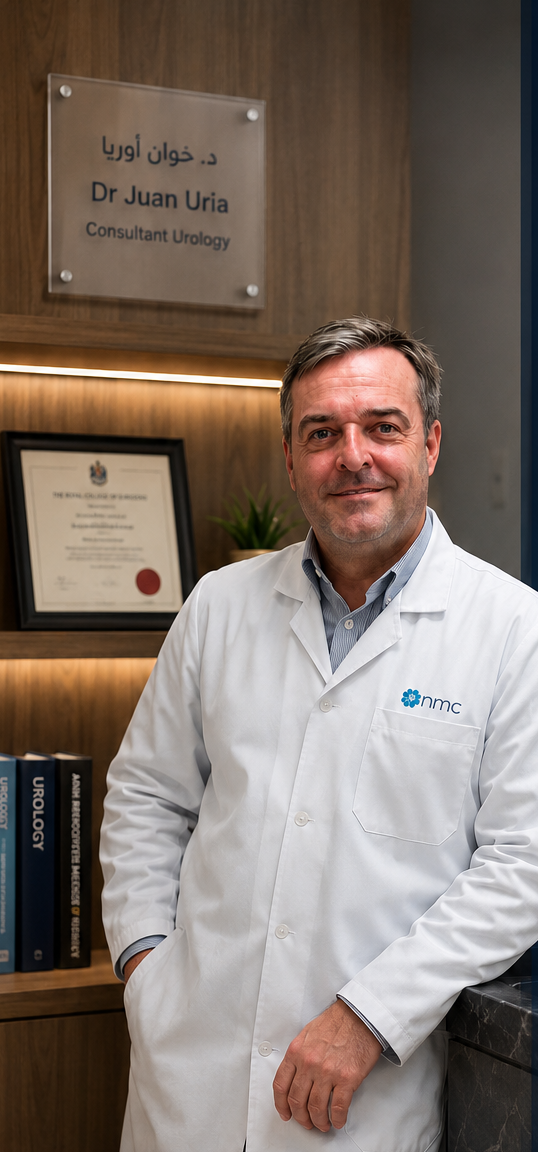
Dr. Juan Uría González-Tova · Consultant Urologist & Andrologist · NMC Royal Hospital Khalifa City, Abu Dhabi
Medically reviewed by Dr. Juan Uría · August 19, 2026
Take the self-assessmentTwo minutes. Nothing is sent or saved.A peptide is a chemical description, not a category of treatment. Insulin is a peptide. So is hCG, so is the GnRH analogue used in prostate cancer, and so is an unlicensed compound bought from a website. Grouping them under one heading is what makes the marketing work: the credibility of the licensed medicines is lent to compounds that have never been through the process the licensed ones went through. The useful question is never "are peptides safe?" but "which peptide, for what, and approved by whom?"
On the licensed side, the peptides that matter in andrology are the ones that talk to the testicle. Human chorionic gonadotropin mimics LH and tells the testis to produce testosterone and to keep working; FSH supports sperm production. Together they are the established treatment for hypogonadotropic hypogonadism — low testosterone caused by the signal from the brain rather than by the testis itself — and they are how testicular function and fertility are preserved in a man who would otherwise be shut down by testosterone replacement. These are real indications with decades of use behind them, and they are prescribed here where they apply.
On the other side sit the compounds the wellness market means by "peptide therapy". BPC-157 and TB-500 are sold for tendon, joint and gut healing on the strength of rodent experiments; no completed randomised trial in humans has been published for either. Ipamorelin, CJC-1295 and sermorelin raise growth hormone indirectly, which is why they are marketed for recovery, body composition and anti-ageing — and why they sit on the World Anti-Doping Agency's prohibited list at all times, in and out of competition. Several of these were placed by the FDA in the category of substances that raise significant safety concerns for compounding. None of that makes them certainly harmful; it means nobody can tell you what they do in humans at the doses being sold, because the studies that would answer that have not been done.
The legal position in the United Arab Emirates deserves stating plainly, because it is the part patients are least often told. Medicines are controlled here, and bringing an unregistered product into the country — ordered online, carried in a suitcase, or posted — is not a grey area. Anything prescribed at NMC Royal Hospital is a registered medicine, obtained through the hospital pharmacy, with a batch number and a manufacturer behind it. A vial bought from a website has none of those things, and its contents are not verifiable by anyone, including the person injecting it.
Check your own symptoms
Is a peptide medicine relevant to you?
A structured screen written for this page. There is no validated questionnaire for peptide therapy, and there could not be: it is a marketing category rather than a diagnosis. These questions do what a consultation does — work back from the goal to the investigation that answers it.
Answer for where you are now. The result tells you which of two very different things you are actually asking about — a licensed medicine with a real indication, or an unapproved compound.
Question 1 of 5
Choose the closest answer
What the assessment involves
A consultation about peptides is, in practice, a consultation about the goal underneath the request — energy, recovery, libido, body composition, fertility. Most of those goals have an established investigation and an established treatment, and the job of the assessment is to find out which one applies before any compound is discussed.
What the goal actually is, stated in plain terms. "Peptides" is a proposed answer; the assessment starts from the question it was proposed for.
A morning hormone profile — total and free testosterone, LH, FSH, prolactin, SHBG — because a low testosterone caused by a failing signal from the pituitary is treated differently from one caused by the testis, and only these tell them apart.
Everything already being taken, including what was bought without a prescription. A significant proportion of men asking about peptides are already using something, and the plan cannot be built without knowing what.
Fertility intentions, asked before anything is started rather than after. Testosterone suppresses sperm production; hCG and FSH exist precisely to work around that, and the order in which they are used depends on whether children are wanted.
The contraindications that matter for anything raising growth hormone — an active or past malignancy above all, alongside diabetes, retinopathy and untreated sleep apnoea.
Sleep, alcohol, training load, body composition and stress — the things that actually move energy and recovery, and that a compound is often being asked to substitute for.
Treatment
Where a licensed peptide medicine is indicated, it is prescribed and it works. Hypogonadotropic hypogonadism — low testosterone with low or inappropriately normal LH and FSH — is treated with hCG, with FSH added when sperm production is the priority, and this restores the testicle's own output rather than replacing it from outside. The same applies to a man on testosterone replacement who wants to protect fertility and testicular volume: hCG alongside it is the standard way to do that, and it is a decision best made at the start rather than after a year of suppression.
The compounds sold as peptide therapy for recovery, growth hormone or anti-ageing are not prescribed here. That is not caution for its own sake: BPC-157 and TB-500 have no completed published human trial to describe an effect or a dose from, the growth hormone secretagogues are prohibited in sport at all times and carry the metabolic and oncological questions that raising growth hormone always carries, and none of them is a registered medicine in the UAE. A doctor who offers them is offering something whose contents, dose-response and long-term effect he cannot state — which is a different transaction from prescribing.
If you are already using something bought online, bring it to the consultation rather than leaving it out. The vial, the label and the supplier tell more than a remembered name, and the conversation is a clinical one, not a disciplinary one. Some of what is being taken can simply be stopped; some — anything suppressing your own hormone production — should be withdrawn in a planned way with bloods before and after, because stopping abruptly is how men end up worse than when they started. The point of asking is to be able to help, and that is not possible around a gap in the history.
For erectile dysfunction specifically, no peptide is a first-line treatment. Bremelanotide acts on the brain rather than the blood vessels and is licensed for low sexual desire in premenopausal women, not for erectile dysfunction in men; any use in men is off-label, sits behind the treatments with real evidence, and brings nausea and blood-pressure effects with it. If erections are the problem, the assessment on the erectile dysfunction page is the place to start, and the treatments that follow from it have decades of trials behind them rather than a marketing category.
Common questions
01Can you prescribe BPC-157, ipamorelin or CJC-1295?
No. None of them is a registered medicine in the UAE, and none has a completed human trial establishing a dose or an effect. That is the reason, and it does not change with the strength of the request. What can be done is to take the goal seriously — recovery, energy, body composition — and investigate it properly, which in a good proportion of men turns up something treatable that the compound would not have fixed anyway.
02Is peptide therapy the same as testosterone replacement?
No, and the difference matters. Testosterone replacement supplies the hormone from outside and switches off the body's own production, including sperm. hCG does the opposite: it stimulates the testicle to produce its own testosterone, which is why it is used when fertility or testicular volume needs preserving. They are sometimes used together for that reason. Which is appropriate depends on where the problem sits — the brain's signal or the testis — and that is what the blood tests are for.
03I have been using peptides I ordered online. Am I in trouble if I tell you?
The consultation is confidential and clinical. What is needed is the name, the dose, how long, and ideally the vial itself, because the plan depends on it — particularly if what you are taking suppresses your own hormone production, in which case stopping it needs to be planned rather than abrupt. Withholding it does not make the risk smaller; it only removes the one person able to do something about it from the picture.
04Are peptides useful for erectile dysfunction or low libido?
Not as a first step. Erectile dysfunction has a diagnostic pathway and treatments with substantial trial evidence, and it is often the first visible sign of a vascular or metabolic problem that a peptide would leave untouched. Low libido is more often a testosterone, thyroid, sleep, medication or mood question than a peptide one. Where a hormonal cause is found and the signal from the pituitary is the problem, the peptide that helps is hCG — and that is a prescription, not a wellness product.
About Dr. Juan Uría
Dr. Juan Uría González-Tova is a Consultant Urologist and Andrologist at NMC Royal Hospital, Khalifa City, Abu Dhabi, with over 30 years of clinical practice. He gained his medical degree at the University of Oviedo and his PhD at the University of Barcelona, and has practised in Abu Dhabi since 2018. Consultations are held in English, Spanish or Catalan.
View Dr. Uría's official NMC profileBook a consultation
Consultations take place at NMC Royal Hospital, Khalifa City, Abu Dhabi, in English, Spanish or Catalan.
Related topics
This page is general medical information and does not replace individual medical advice, diagnosis or treatment. If you have symptoms, seek assessment from a licensed physician.