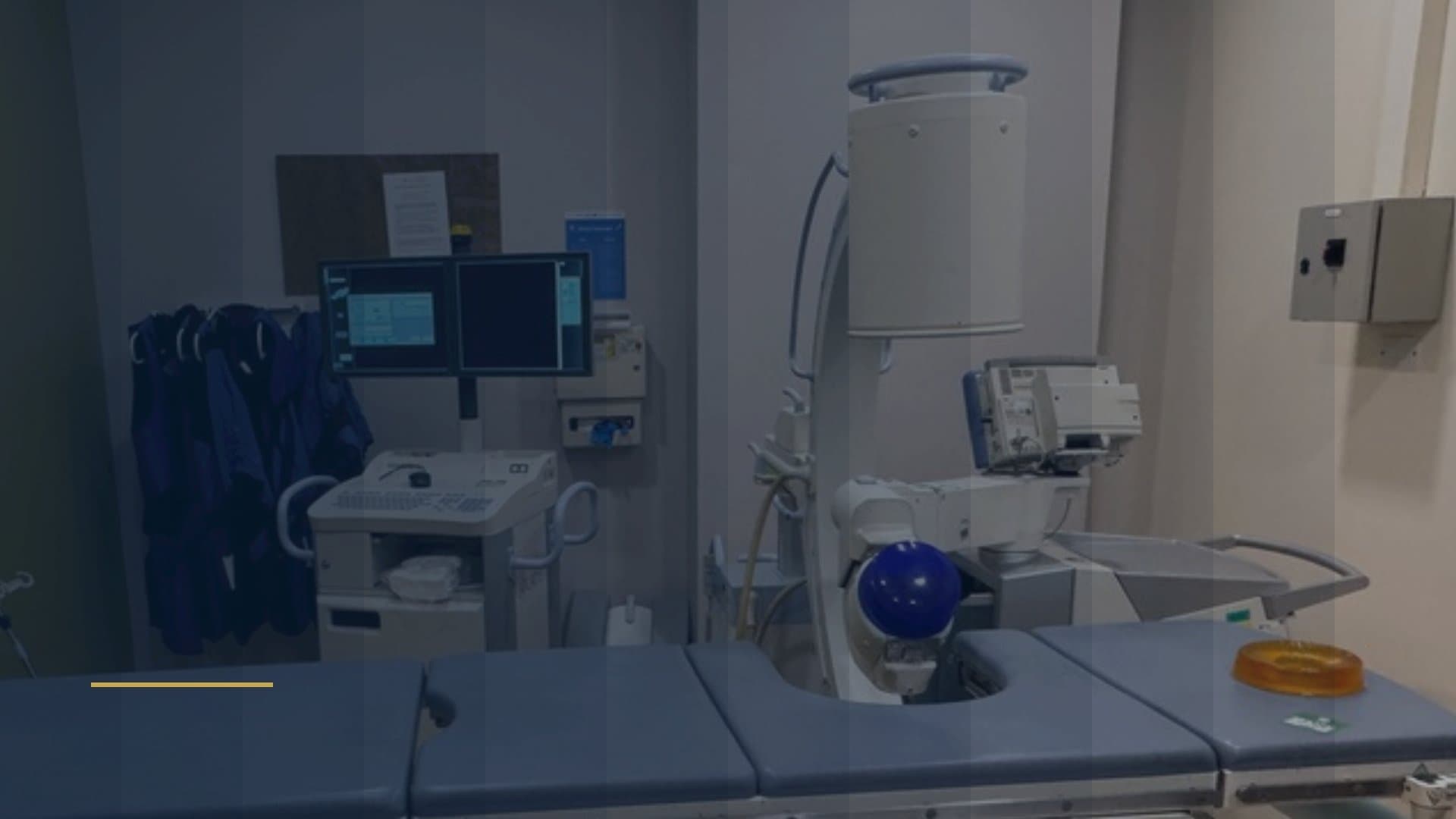
Shockwave Lithotripsy (ESWL) for Kidney Stones in Abu Dhabi
Shockwave lithotripsy breaks a stone from outside the body, with focused acoustic waves and no incision at all. It is the least invasive stone treatment there is, and it is not the most effective one: for most stones ureteroscopy clears more of them in a single session. The trade is real and it is the whole decision — ESWL means no instrument inside you, at the cost of a lower chance of being stone-free first time and a higher chance of needing a second treatment.
- Confidential consultation
- Consultant Urologist & Andrologist
- NMC Royal Hospital, Abu Dhabi
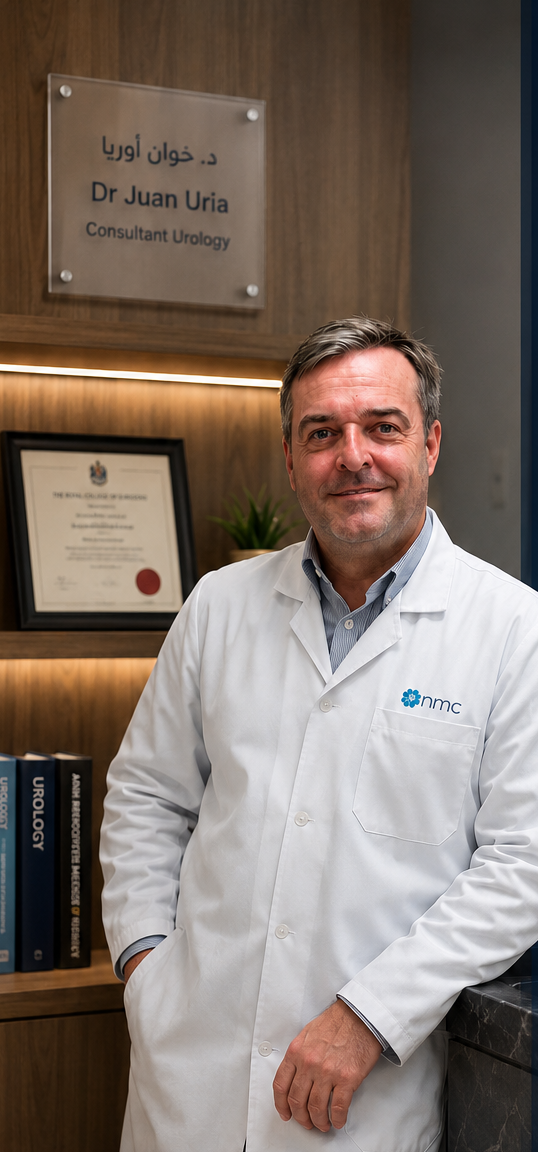
Dr. Juan Uría González-Tova · Consultant Urologist & Andrologist · NMC Royal Hospital Khalifa City, Abu Dhabi
Medically reviewed by Dr. Juan Uría · August 20, 2026
Take the self-assessmentTwo minutes. Nothing is sent or saved.The machine focuses shock waves generated outside the body onto the stone, located by X-ray or ultrasound. Around two to three thousand waves are delivered over roughly forty-five minutes, under sedation rather than general anaesthesia in most cases, and the patient goes home the same day. The stone is not removed; it is fragmented, and the fragments then have to pass on their own over the following days to weeks. That passing is the part patients are least prepared for, and it can be uncomfortable.
Whether it works is decided almost entirely before the machine is switched on. Size, position and density are what predict success: stones under a centimetre do well, stones over two centimetres generally do not, stones in the lower pole of the kidney clear less reliably because the fragments have to travel uphill, and dense stones — cystine, brushite, calcium oxalate monohydrate, anything above roughly a thousand Hounsfield units on CT — resist fragmentation. Skin-to-stone distance matters too, which is why body habitus is part of the assessment rather than an awkward aside.
It is not offered to everyone. Pregnancy, an untreated urinary infection, uncorrected clotting problems and an obstruction below the stone all rule it out, and an infected obstructed kidney is an emergency needing drainage rather than lithotripsy. Where an infection is present it is treated first, because fragmenting a stone that harbours bacteria can release them into the bloodstream.
Check your own symptoms
Is lithotripsy likely to work on your stone?
A structured screen written for this page, built from the stone characteristics that predict fragmentation. It is a reading of your CT report, not a substitute for one.
Have your CT report to hand if you have one — size in millimetres and density in Hounsfield units are the two numbers that matter most.
Question 1 of 5
Choose the closest answer
What the assessment involves
The assessment for lithotripsy is mostly a reading of the CT scan. What the stone is made of, where it sits and how far it is from the skin decide whether shock waves will break it, and those answers exist before any appointment for treatment is made.
A non-contrast CT, which is the only imaging that gives size, position and density together. An ultrasound alone cannot plan lithotripsy.
Stone density in Hounsfield units, because it predicts fragmentation better than size does and is the single most useful number on the report.
Whether the kidney below the stone drains freely. Shock waves make fragments, and fragments need somewhere to go.
A urine culture, cleared before treatment rather than after. This is the check that prevents the serious complication.
Anticoagulants and antiplatelet drugs, which have to be planned around and never stopped by the patient alone.
What matters more to you — avoiding an instrument and an anaesthetic, or the highest chance of being clear after one procedure. Both are legitimate answers, and they lead to different treatments.
Common questions
01Does it hurt?
The treatment itself is done under sedation and is generally well tolerated — a deep tapping sensation rather than sharp pain. The days afterwards are the harder part: passing fragments can produce colic of the same kind the original stone caused, and pain relief is prescribed for exactly that reason. Blood in the urine for a few days is expected and not a complication.
02How likely am I to need a second session?
It depends almost entirely on the stone rather than on you. Small, low-density stones in a favourable position often clear in one; larger, denser or lower-pole stones frequently need a second, and sometimes a third. This is worth agreeing in advance, because a treatment described as one session and delivered as three feels like a failure even when the outcome is good. If two sessions have not worked, the answer is usually to change technique rather than to repeat it again.
03Will I need a stent?
Usually not for a small stone. A stent is placed when the stone is large enough that the fragments could obstruct the ureter on their way down, when there is only one working kidney, or when the kidney is already obstructed. Stents prevent a blockage but they are themselves uncomfortable — urinary frequency, urgency and flank discomfort when passing urine are normal with one in — so they are used where the risk justifies it rather than routinely.
About Dr. Juan Uría
Dr. Juan Uría González-Tova is a Consultant Urologist and Andrologist at NMC Royal Hospital, Khalifa City, Abu Dhabi, with over 30 years of clinical practice. He gained his medical degree at the University of Oviedo and his PhD at the University of Barcelona, and has practised in Abu Dhabi since 2018. Consultations are held in English, Spanish or Catalan.
View Dr. Uría's official NMC profileBook a consultation
Consultations take place at NMC Royal Hospital, Khalifa City, Abu Dhabi, in English, Spanish or Catalan.
Related topics
This page is general medical information and does not replace individual medical advice, diagnosis or treatment. If you have symptoms, seek assessment from a licensed physician.