Kidney Stone Treatment in Abu Dhabi
Kidney stones are common in the Gulf, and the climate is part of the reason: sustained heat and inadequate fluid intake concentrate the urine, which is the condition in which stones form. Most stones can be treated without an open operation, and the part that is too often skipped is what happens afterwards — without prevention, roughly half of people who form one stone form another within a decade.
- Confidential consultation
- Consultant Urologist & Andrologist
- NMC Royal Hospital, Abu Dhabi
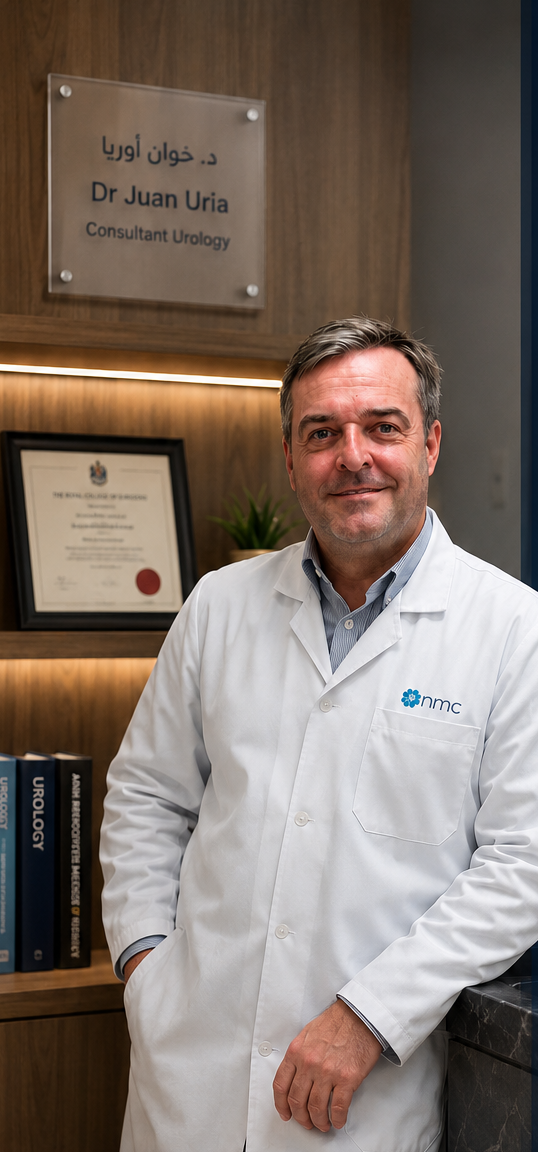
Dr. Juan Uría González-Tova · Consultant Urologist & Andrologist · NMC Royal Hospital Khalifa City, Abu Dhabi
Medically reviewed by Dr. Juan Uría · August 19, 2026
Take the self-assessmentTwo minutes. Nothing is sent or saved.Renal colic — sudden severe pain in the flank, often radiating to the groin, with nausea and sometimes blood in the urine — is how most stones announce themselves. Not every stone needs an intervention: small ones frequently pass with fluids, pain relief and time. Size, position and whether the kidney is obstructed decide that, and a CT scan answers all three quickly.
Two situations are not a matter of choice. A stone obstructing a kidney in the presence of infection is an emergency — the kidney must be drained without delay — and an obstructed solitary kidney is treated with the same urgency. Outside those, the choice between shockwave lithotripsy, ureteroscopy with laser fragmentation and percutaneous surgery is made on stone size, hardness, position and the patient's own anatomy, not on preference for one technique.
The stone itself is the episode; the tendency to form stones is the condition. Analysing the stone that was passed or removed, together with blood and urine tests, identifies the metabolic reason in a substantial proportion of people — and that is what turns treatment into prevention. In this climate the single most effective measure is usually the least medical one: enough fluid, consistently, to keep the urine pale.
Check your own symptoms
Kidney stone risk and symptom check
A structured screen written for this page, covering the two questions a stone patient actually has: is this pain a stone, and why do I keep making them. The recurrence factors follow the metabolic risk factors used in stone prevention clinics.
The climate here matters more than most risk factors on this list: chronic mild dehydration is the single most common reason stones form in the Gulf, and it is also the most correctable.
Question 1 of 7
Choose the closest answer
What the assessment involves
The assessment answers two questions at once: what to do about this stone, and what to do so there is not another one.
Low-dose CT to establish size, position, density and whether the kidney is obstructed
Urine culture and inflammatory markers, since infection behind an obstruction changes the treatment from elective to urgent
Kidney function and, where relevant, the anatomy of the collecting system
Stone analysis whenever a stone is passed or retrieved — it is the single most informative test for preventing the next one
Metabolic work-up in recurrent stone formers, covering calcium, uric acid, citrate and 24-hour urine volume
Treatment
A stone that is small, not obstructing and causing controllable pain can be given time to pass, with analgesia and sometimes a medication to relax the ureter. Two situations override that entirely: obstruction with fever or signs of infection is an emergency and the kidney is drained the same day, by stent or nephrostomy, before any attempt to treat the stone itself; and an obstructed solitary or transplanted kidney is treated with the same urgency. Uncontrolled pain, vomiting or deteriorating kidney function also end the waiting.
Where the stone has to be treated, three techniques cover almost everything and the choice is made on imaging, not preference. Shockwave lithotripsy fragments the stone from outside the body, needs no incision and suits smaller, softer stones in favourable positions; the fragments still have to pass. Flexible ureteroscopy with laser fragmentation reaches the stone directly, handles hard stones and most ureteric stones, and clears them in one session with high success. Percutaneous nephrolithotomy, through a small track in the flank, is the answer for large or staghorn stones inside the kidney. A stent is often left temporarily afterwards, and the discomfort it causes is normal, finite and worth explaining in advance.
Prevention is the half of the treatment that is usually skipped, and in this climate it is the half that matters most. The stone is analysed, and blood and 24-hour urine testing identify the metabolic pattern. Fluid intake sufficient to keep urine pale — judged by colour rather than by a fixed number of litres, because heat and outdoor work change the requirement — is the single most effective measure for every stone type. Beyond that: normal dietary calcium rather than restricted, less salt and less animal protein, and, where testing shows it, a thiazide for high urinary calcium, potassium citrate for low citrate or uric acid stones, or allopurinol where uric acid is the driver.
Common questions
01Will my stone pass on its own?
It depends mostly on size and position. Small stones in the lower ureter often pass with fluids, pain relief and time, and larger ones increasingly do not. A stone that is not passing, that is causing uncontrolled pain, or that is obstructing a kidney needs treating rather than waiting out — and obstruction with fever needs treating the same day.
02Which treatment will I need?
Shockwave lithotripsy breaks the stone from outside the body and suits smaller, softer stones in favourable positions. Ureteroscopy passes a fine telescope up to the stone and fragments it with a laser, which handles harder stones and most ureteric ones. Percutaneous surgery, through a small track in the flank, is for large stones inside the kidney. The stone's size, density, position and your anatomy decide which — and that is a decision made after imaging, not before.
03Why do I keep forming stones?
Usually because urine is too concentrated too much of the time, sometimes because of a specific metabolic abnormality, and often both. Recurrent stone formation is worth investigating properly rather than treating episode by episode: stone analysis plus blood and urine testing identifies a treatable cause in a substantial share of people, and the measures that follow are mostly dietary and habitual rather than surgical.
04How much should I drink in this climate?
Enough that the urine stays pale through the day, which in the UAE summer and for anyone working outdoors means noticeably more than the standard advice — losses through sweat do not appear in the toilet but do concentrate the urine. Judging it by the colour of the urine rather than by a fixed number of litres adjusts automatically for heat and activity.
About Dr. Juan Uría
Dr. Juan Uría González-Tova is a Consultant Urologist and Andrologist at NMC Royal Hospital, Khalifa City, Abu Dhabi, with over 30 years of clinical practice. He gained his medical degree at the University of Oviedo and his PhD at the University of Barcelona, and has practised in Abu Dhabi since 2018. Consultations are held in English, Spanish or Catalan.
View Dr. Uría's official NMC profileBook a consultation
Consultations take place at NMC Royal Hospital, Khalifa City, Abu Dhabi, in English, Spanish or Catalan.
Related topics
This page is general medical information and does not replace individual medical advice, diagnosis or treatment. If you have symptoms, seek assessment from a licensed physician.