
Male Infertility Specialist in Abu Dhabi
A male factor contributes in roughly half of couples who have difficulty conceiving, either alone or alongside a female factor. This means the man should be assessed from the start rather than after the female investigation has concluded — and that assessment begins with a semen analysis, which is simple, quick and frequently skipped.
- Confidential consultation
- Consultant Urologist & Andrologist
- NMC Royal Hospital, Abu Dhabi
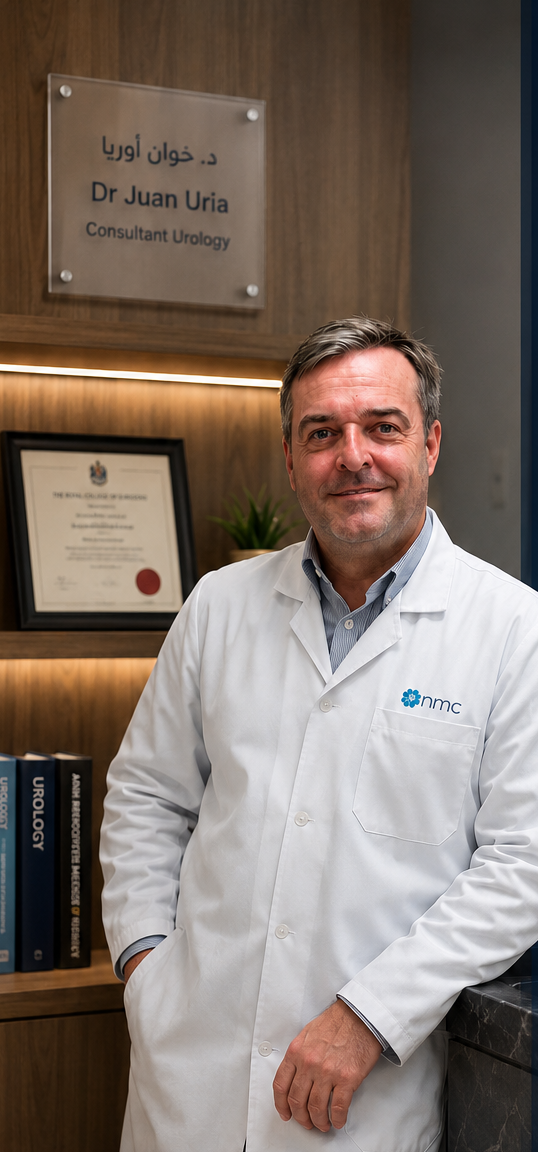
Dr. Juan Uría González-Tova · Consultant Urologist & Andrologist · NMC Royal Hospital Khalifa City, Abu Dhabi
Medically reviewed by Dr. Juan Uría · August 19, 2026
Take the self-assessmentTwo minutes. Nothing is sent or saved.Some causes of male infertility are correctable and some are not, which is precisely why they need to be distinguished rather than assumed. Varicocele, hormonal disorders, infection, obstruction and the effects of medication or anabolic steroid use are all potentially treatable. Genetic and primary testicular causes are not, but identifying them changes the plan and avoids wasted time.
One result deserves particular emphasis: previous or current testosterone use is a common and reversible cause of a very low or zero sperm count, and it is regularly missed because patients do not think to mention supplements or injections obtained outside a clinic. Assessment also has value beyond fertility, since semen quality correlates with general and hormonal health.
Check your own symptoms
Male fertility risk screen
A structured history screen written for this page. No questionnaire can assess male fertility — only a semen analysis can — so these questions cover the history that decides how urgently that test is needed and what should be tested alongside it.
Fertility is assessed as a couple, and roughly half of the time a male factor is involved. These questions are about you; your partner's assessment runs in parallel, not afterwards.
Question 1 of 7
Choose the closest answer
What the assessment involves
The purpose is to determine whether there is a male factor, whether it has a reversible cause, and what the realistic route to conception is for this couple.
Semen analysis, repeated to confirm, since single results vary considerably
History covering medication, anabolic steroid or testosterone use, infection, surgery and heat exposure
Physical examination including testicular volume and assessment for varicocele
Hormone profile: FSH, LH, total testosterone and prolactin
Scrotal ultrasound, with genetic testing where the sperm count is severely reduced or absent
Treatment
Treatment starts from the cause, and a number of causes are correctable. Varicocele repair improves semen parameters in appropriately selected men and is one of the few interventions that can restore natural conception. Hormonal deficiency is corrected — with agents that stimulate the man's own production, never with testosterone, which suppresses sperm production and is a recognised cause of the very problem being treated. Infection, medication, anabolic steroid use, heat exposure, smoking, obesity and poorly controlled diabetes all have a measurable effect and all are modifiable.
Where no sperm appear in the ejaculate, the distinction that matters is obstruction versus failure of production. Obstruction is often surgically correctable, and sperm can reliably be retrieved. Where production is the problem, microsurgical testicular sperm extraction recovers usable sperm in a substantial proportion of men even when standard retrieval has failed, and genetic testing is done first because some findings change both the prognosis and what the couple should be told before proceeding.
Two points of sequencing matter more than any single treatment. The female partner is assessed in parallel, not afterwards — in roughly half of couples both partners contribute, and treating one alone wastes the time that matters most. And assisted reproduction is a destination, not a default: where a correctable male factor exists, correcting it first can move a couple from ICSI to IUI, or to natural conception, and that is a materially different path in cost, invasiveness and outcome.
Common questions
01How long should we try before getting assessed?
Twelve months of regular unprotected intercourse without conception is the usual threshold, reduced to six months if the female partner is over 35 or there is a known risk factor in either partner. A semen analysis is simple enough that there is little reason to delay it once the question has arisen.
02Does a poor semen analysis mean I cannot have children?
No. A single abnormal result is not a diagnosis — values fluctuate with illness, fever, abstinence interval and laboratory technique, which is why the test is repeated. Even confirmed abnormal results have treatable causes in many cases, and assisted reproduction routes exist for those that do not.
03I took testosterone at the gym. Does that matter?
It matters a great deal, and it is important to say so openly. Testosterone and anabolic steroids suppress sperm production and are a frequent cause of very low or absent counts in otherwise healthy young men. Recovery is common once they are stopped, but it takes months and needs to be managed, so this information changes the plan rather than the assessment of the patient.
About Dr. Juan Uría
Dr. Juan Uría González-Tova is a Consultant Urologist and Andrologist at NMC Royal Hospital, Khalifa City, Abu Dhabi, with over 30 years of clinical practice. He gained his medical degree at the University of Oviedo and his PhD at the University of Barcelona, and has practised in Abu Dhabi since 2018. Consultations are held in English, Spanish or Catalan.
View Dr. Uría's official NMC profileBook a consultation
Consultations take place at NMC Royal Hospital, Khalifa City, Abu Dhabi, in English, Spanish or Catalan.
Related topics
This page is general medical information and does not replace individual medical advice, diagnosis or treatment. If you have symptoms, seek assessment from a licensed physician.