Testosterone Deficiency & TRT Clinic in Abu Dhabi
Testosterone deficiency, or male hypogonadism, is diagnosed when consistently low morning testosterone levels occur together with compatible symptoms — not on a single blood test and not on symptoms alone. Testosterone replacement therapy is effective when that diagnosis is correct, and inappropriate when it is not, which makes accurate diagnosis the whole of the problem.
- Confidential consultation
- Consultant Urologist & Andrologist
- NMC Royal Hospital, Abu Dhabi
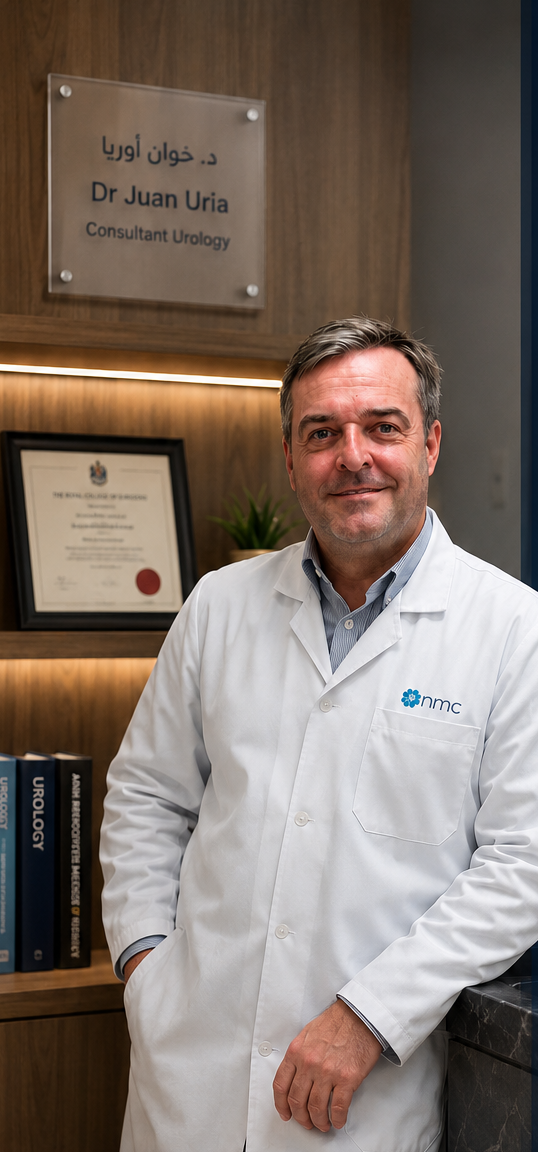
Dr. Juan Uría González-Tova · Consultant Urologist & Andrologist · NMC Royal Hospital Khalifa City, Abu Dhabi
Medically reviewed by Dr. Juan Uría · August 19, 2026
Take the self-assessmentTwo minutes. Nothing is sent or saved.Symptoms attributed to low testosterone — fatigue, reduced libido, low mood, loss of muscle mass, poor concentration — are real but not specific. Thyroid disease, sleep apnoea, depression, iron deficiency, chronic stress and obesity produce a very similar picture. A symptom list alone cannot make this diagnosis, which is why prescribing on symptoms is unsafe practice.
Testosterone replacement also has consequences that must be discussed before starting, not after. It suppresses sperm production and can impair fertility, it requires ongoing monitoring of haematocrit and prostate parameters, and in most cases it is a long-term commitment rather than a short course. These are the reasons TRT belongs in a supervised clinical pathway.
Check your own symptoms
Testosterone deficiency screen (ADAM)
These are the ten questions of the ADAM questionnaire (Androgen Deficiency in the Ageing Male), the screening tool most widely used before a testosterone blood test.
Answer yes or no for how you have felt over the last few months. ADAM is sensitive but not specific: it is good at flagging men who should have a blood test, and poor at telling you the answer without one.
Question 1 of 11
Choose the closest answer
What the assessment involves
The purpose of the assessment is to establish whether testosterone deficiency is genuinely present, whether it has a reversible cause, and whether replacement is the right answer for this patient at this point in his life.
At least two morning total testosterone measurements, taken fasting on separate days
LH, FSH and prolactin, to distinguish testicular from pituitary causes
SHBG and free testosterone where total levels are borderline
Screening for the conditions that mimic it: thyroid function, ferritin, sleep apnoea, mood
Baseline haematocrit, PSA and a documented conversation about fertility intentions
Treatment
Replacement is started only when low morning testosterone on two separate samples sits alongside symptoms that fit. A low number without symptoms is not treated, and symptoms without a low number are not treated with testosterone. Before replacement, the reversible drivers are addressed: weight, untreated sleep apnoea, opioids and corticosteroids, alcohol, and poorly controlled diabetes all suppress testosterone, and correcting them raises it without any prescription at all.
One conversation has to happen before the first dose: testosterone suppresses sperm production, and in some men that does not fully recover. Any man who may want children is not started on replacement without discussing it, and is treated instead with agents that raise his own production — clomiphene or hCG — which achieve the symptomatic benefit while preserving fertility. This is the single most common avoidable harm in testosterone prescribing, and it is entirely avoidable by asking the question first.
Where replacement is right, it is a long-term commitment with structured monitoring rather than a prescription repeated indefinitely. Gels give steadier levels and carry a transfer risk to partners and children; long-acting injections are more convenient and produce peaks and troughs. Testosterone, haematocrit and PSA are checked at three and six months and then annually — a rising haematocrit is the commonest reason to reduce or pause. Symptoms are reassessed honestly at six months: if they have not improved, testosterone was not the cause, and continuing is not the answer.
Common questions
01Will TRT affect my fertility?
Yes. Exogenous testosterone suppresses the hormonal signal that drives sperm production, and can reduce sperm counts substantially, in some cases to zero. Recovery after stopping is usual but neither guaranteed nor quick. If you may want children, say so before starting — alternative approaches exist that do not carry this effect.
02Is one blood test enough to diagnose low testosterone?
No. Testosterone follows a daily rhythm and falls with acute illness, poor sleep and stress, so a single low reading is unreliable. Diagnosis requires at least two low morning measurements on separate days, interpreted alongside symptoms and the hormones that explain the cause.
03Is testosterone therapy legal in the UAE?
Testosterone is a controlled prescription medicine in the UAE. It is legal when prescribed by a licensed physician for a documented medical indication and dispensed through a licensed pharmacy. Obtaining it any other way is both a legal risk and an unmonitored medical one.
04How long before I notice a difference?
Different effects appear on different timescales. Libido and mood tend to respond within weeks, while changes in body composition and bone density take months. Monitoring continues throughout, because dose adjustment is based on measured response rather than on how a patient expects to feel.
About Dr. Juan Uría
Dr. Juan Uría González-Tova is a Consultant Urologist and Andrologist at NMC Royal Hospital, Khalifa City, Abu Dhabi, with over 30 years of clinical practice. He gained his medical degree at the University of Oviedo and his PhD at the University of Barcelona, and has practised in Abu Dhabi since 2018. Consultations are held in English, Spanish or Catalan.
View Dr. Uría's official NMC profileBook a consultation
Consultations take place at NMC Royal Hospital, Khalifa City, Abu Dhabi, in English, Spanish or Catalan.
Related topics
This page is general medical information and does not replace individual medical advice, diagnosis or treatment. If you have symptoms, seek assessment from a licensed physician.